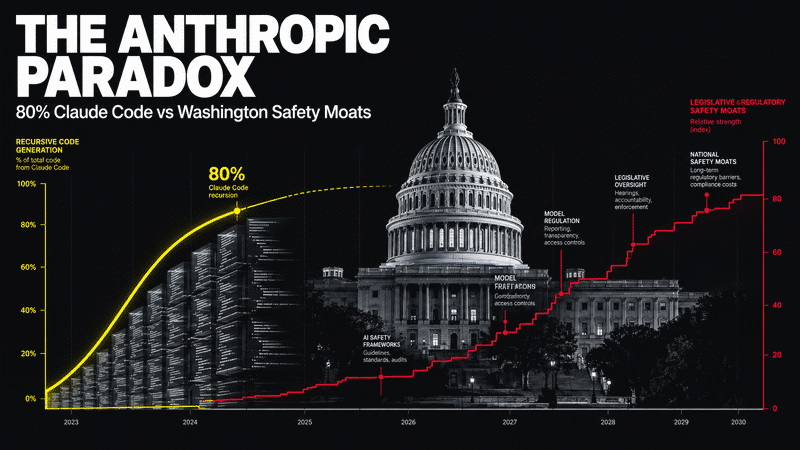
Inside Anthropic, Claude generates 80% of production code and strains CI systems. Outside, executive calls for safety slowdowns face fierce regulatory backlash. The leading frontier lab finds itself caught between two conflicting realities. Internally, autonomous agents are generating code at unprecedented scale, pushing continuous integration pipelines to collapse. Externally, executive leadership is lobbying Congress to slow down frontier training and mandate third-party evaluation. Critics argue this dual strategy creates an anti-competitive regulatory moat. The unfolding confrontation exposes the true costs of recursive AI progress.
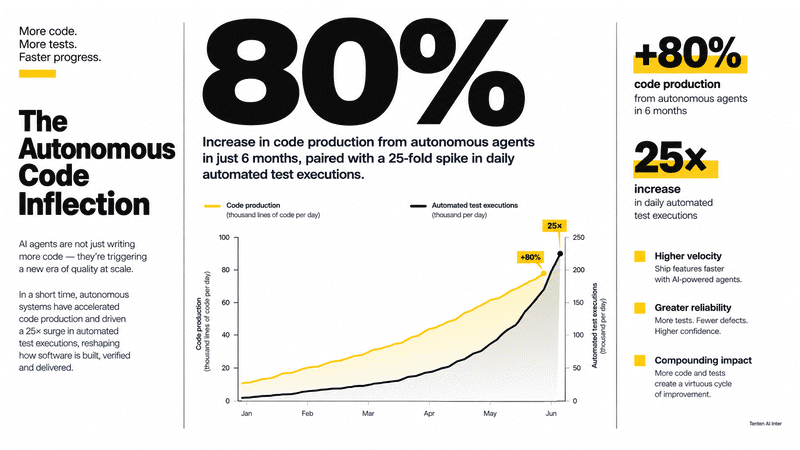
Autonomous Code Generation Triggers a 25x Testing Surge
AI assistance is transforming production software development into an extreme throughput challenge. Recent internal disclosures from Anthropic indicate that engineering teams now deliver eight times more code per quarter than historical baselines. Claude autonomously authors over 80% of all merged code across the company.
This massive volume shift overwhelmed core infrastructure within six months. The explosion of generated code caused a tenfold expansion in test suites, driving a 25-fold surge in daily Continuous Integration (CI) task volume.
| Development Metric | Baseline Benchmark | Post-Deployment State | Infrastructure Consequence |
|---|---|---|---|
| Quarterly Code Output | Standard team velocity | 8x baseline delivery | Human review queues become bottlenecks |
| Agent-Authored Code | Minimal (<15%) | Over 80% written by Claude | Engineers shift toward specification review |
| Test Suite Volume | Linear progression | 10x test case growth | Comprehensive test execution runs stall |
| Daily CI Workloads | Predictable fleet capacity | 25x workload expansion | Test Impact Analysis infrastructure fails |
The primary breakdown occurred within Anthropic's Test Impact Analysis (TIA) service. Designed to run only tests affected by specific code diffs, the system could not keep pace with simultaneous agent submissions. Database write delays exceeded 20 minutes during peak hours.
Stale state records poisoned subsequent validation runs. Passing tests were skipped, while obsolete failures blocked deployment pipelines. Autonomous agents entered unproductive loops attempting to debug ghost errors. Engineering teams applied three successive emergency patches. The first patch survived 70 days, the second lasted 29 days, and the third collapsed within 24 hours. The team ultimately rebuilt the entire architecture to decouple test scheduling from historical state caching. The lesson is definitive: code generation is no longer the bottleneck, but verification throughput is.
Washington Scrutiny: The $7.7 Billion Foundation Alignment
While internal systems grapple with hyper-acceleration, CEO Dario Amodei has consistently urged Washington lawmakers to intervene. In congressional testimonies and media appearances, Amodei argues that frontier models pose existential societal risks. He insists that labs cannot grade their own work and urges federal mandates for independent evaluations and training caps.
However, an independent financial audit circulating in Washington has cast doubt on the objectivity of this crusade. Investigative findings reveal that prominent safety evaluation bodies, including METR, draw funding from charitable foundations holding substantial equity stakes in Anthropic, valued at approximately $7.7 billion.
┌───────────────────────────────────────────────────────────┐
│         The Washington AI Safety Alignment Cycle          │
└───────────────────────────────────────────────────────────┘
                           │
                           ▼
┌───────────────────────────────────────────────────────────┐
│ 1. Foundations hold an estimated $7.7B in Anthropic equity │
└──────────────────────────┬────────────────────────────────┘
                           │ Grants and endowment distributions
                           ▼
┌───────────────────────────────────────────────────────────┐
│ 2. Funding sustains third-party eval bodies and think tanks │
└──────────────────────────┬────────────────────────────────┘
                           │ Publishes catastrophic risk alerts
                           ▼
┌───────────────────────────────────────────────────────────┐
│ 3. Lawmakers urged to impose licensing and compute barriers │
└──────────────────────────┬────────────────────────────────┘
                           │ Disqualifies underfunded challengers
                           ▼
┌───────────────────────────────────────────────────────────┐
│ 4. Incumbent market power solidifies, lifting valuations  │
└───────────────────────────────────────────────────────────┘
The conflict of interest is structural. If an evaluation partner were to block an Anthropic model deployment, Anthropic's valuation would drop. The resulting balance-sheet contraction would jeopardize the endowment funding the evaluation apparatus. When examiners hold equity in the examined lab, claim of independent oversight weakens under legislative scrutiny.
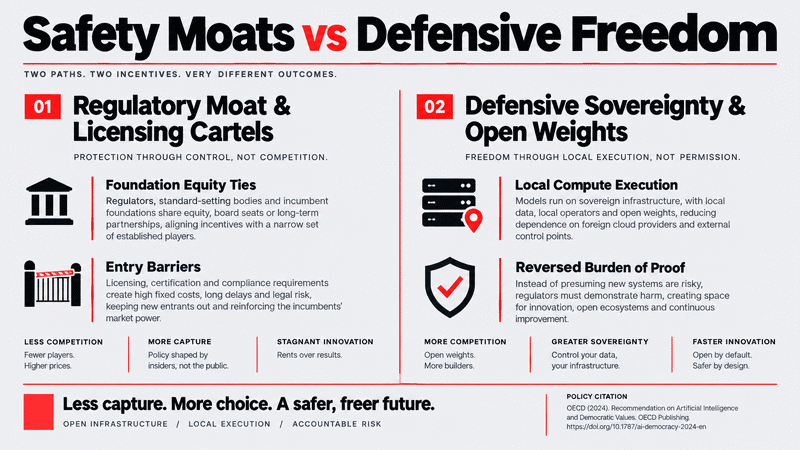
Defense Before Restriction: The Pushback Against Regulatory Capture
Industry leaders and open-source advocates are mounting a vigorous counter-argument against top-down deceleration treaties. The central disagreement focuses on governance authority: who decides what constitutes intolerable risk, and who possesses the mandate to restrict open competition.
Diverging from incumbent proposals, market advocates emphasize three counter-principles:
- Reversed Burden of Proof: Frontier models should remain default-permitted for deployment. Any prohibition requires demonstrable evidence of catastrophic harm that targeted sandboxing and permission controls cannot mitigate.
- Defense Prior to Restriction: Enforcing development pauses disarms defensive practitioners. Security researchers require unrestricted access to frontier intelligence to identify vulnerabilities and engineer robust guardrails.
- Preventing Regulatory Capture: Compliance regimes designed by well-funded incumbents establish prohibitive licensing barriers. Startups and independent developers cannot absorb multi-million-dollar safety audits.
When dominant labs use autonomous agents to produce 80% of their software while advocating for government-enforced training restrictions, market observers suspect defensive rent-seeking. Sustainable technological safety cannot depend on regulatory cartels.
The Freedom to Leave: Open Weights as Strategic Insurance
Beneath policy posturing lies an essential technical imperative: the freedom to leave. Developers who rely exclusively on proprietary cloud APIs surrender operational sovereignty to external vendors.
Suppliers can unilaterally raise token tariffs, modify model behavioral filters, or suspend account access without recourse. Defensive researchers investigating agent vulnerabilities have repeatedly found their forensic tools blocked by proprietary provider safety layers. In critical defensive scenarios, local open-weight models remain the only dependable, censorship-resistant infrastructure.
Effective AI safety governance will not emerge from closed corporate summits. Lasting stability requires public compute allocations, capability-based rather than capital-based thresholds, and ironclad protection for developers building on private hardware.
Frequently Asked Questions
Does autonomous code generation mean human software engineers are obsolete?
Human software engineering is undergoing an evolutionary shift rather than obsolescence. At Anthropic, engineers spend less time writing boilerplate syntax and more time defining architectural constraints, managing multi-agent tickets, and debugging integration pipelines. Human judgment remains indispensable for strategic system boundaries.
Why does Continuous Integration fail when development teams deploy coding agents?
Traditional CI/CD pipelines assume human typing speeds and episodic pull requests. Autonomous agents generate intricate, high-frequency diffs continuously throughout the day. This volume saturates build runners, invalidates cached dependencies, and overloads test impact analysis databases.
What constitutes regulatory capture in the frontier AI sector?
Regulatory capture occurs when entrenched commercial leaders influence policy standards to create expensive compliance mandates. These requirements increase entry costs for emerging competitors while cementing the market dominance of well-capitalized incumbents.
Why are open-weight models critical for AI safety research?
Proprietary cloud APIs enforce platform-level behavioral filters that can interfere with defensive testing and vulnerability analysis. Open-weight models running on local hardware allow security teams to conduct exhaustive red-teaming without remote monitoring or arbitrary policy constraints.
Sources
- Anthropic — Challenges in Scaling Automated Testing with Claude
- U.S. Senate Committee on the Judiciary — Oversight of A.I.: Legislating on Artificial Intelligence
- METR — Model Evaluation and Threat Research Operational Framework
- Federal Trade Commission — Market Defense and Regulatory Compliance in AI Ecosystems
Author Insight
The current debate surrounding Anthropic reflects the inevitable collision between raw engineering momentum and regulatory politics. Internally, Claude delivers 80% of production code, exposing acute infrastructure constraints that demand fundamental architectural rewrites. Externally, calls for government-enforced safety slowdowns trigger intense skepticism due to multi-billion-dollar endowment ties between advocacy groups and tested labs.
Genuine technical safety is not achieved by imposing licensing cartels. As software teams integrate autonomous agents, sustainable operations depend on scalable verification pipelines, private infrastructure resilience, and the independence to run models without single-vendor vulnerability.
About the author
Crafting seamless user experiences with a passion for headless CMS, Vercel deployments, and Cloudflare optimization. I'm a Full Stack Developer with expertise in building modern web applications that are blazing fast, secure, and scalable. Let's connect and discuss how I can help you elevate your next project!
Comments
Join the discussionNo comments yet. Be the first to comment.