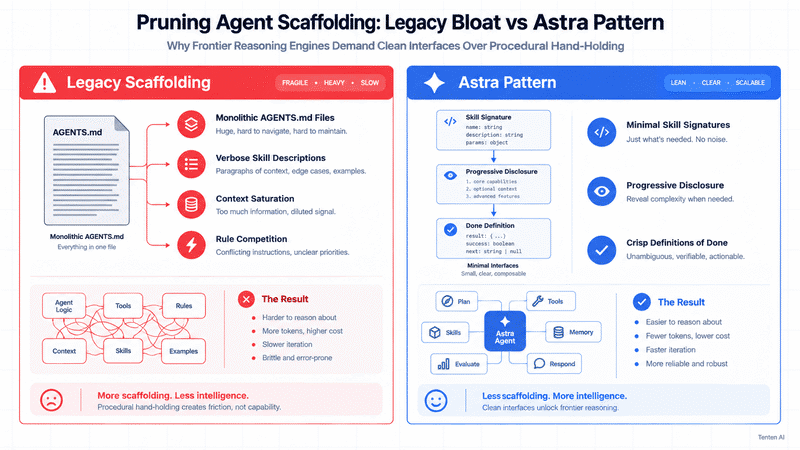
On September 11, 2026, OpenAI published its architecture guide for GPT-6 Astra. It advises engineering teams to strip away defensive prompt scaffolding. Massive AGENTS.md rulebooks and verbose skill descriptions saturate context windows and trigger paralyzing instruction conflicts. OpenAI recommends three core architectural shifts: prune skill descriptions to primary functions and triggers, implement progressive disclosure for complex workflows, and replace rigid micro-step instructions with crisp definitions of done.
In autonomous software engineering, teams often develop an understandable defensive habit. Whenever an AI coding agent misinterprets an instruction, engineers append fresh guardrails to system prompts, AGENTS.md files, or custom skill definitions. Over months of development, a simple patch task ends up burdened by thousands of lines of procedural manuals.
With the release of GPT-6 Astra, OpenAI Developer Relations issued a direct warning: excessive defensive prompt scaffolding degrades agent performance rather than improving accuracy. For frontier reasoning models, procedural bloat is a liability.
Context Bloat and Semantic Truncation: Why Verbose Skill Descriptions Disorient Agents
Modern agentic runtimes register available skills by preloading their names and frontmatter descriptions into the initial system context. When a repository accumulates dozens of specialized skills, and each skill description contains exhaustive step-by-step instructions, the system prompt rapidly fills up with non-essential tokens.
This token bloat produces serious operational consequences. If the agentic harness truncates descriptions to preserve reasoning space, critical routing criteria disappear. Stripped of explicit boundary conditions, the model frequently misroutes tasks or calls unnecessary tools.
OpenAI provides a straightforward design principle: keep skill descriptions minimal. An effective skill definition answers only two fundamental questions:
- What specific engineering problem does this tool solve?
- Under what precise file conditions or triggers should the agent invoke it?
Detailed operational instructions, boundary parameters, and edge-case guides belong in secondary documentation files. They should never crowd the persistent system context.
Instruction Conflict: Resolving the Paralysis Between Autonomy and Permission
Scaffolding bloat also triggers rule collisions across layered configuration files.
In large engineering repositories, different teams contribute specialized skills and local instructions. One performance-oriented skill might instruct the agent to run autonomously and complete multi-file refactors without interruption. A security-focused review skill might order the agent to halt and prompt for human approval before executing any terminal command or writing a file.
When GPT-6 Astra ingests these contradictory mandates simultaneously, the model encounters a severe logical deadlock. Advanced reasoning engines maintain long chains of thought. Forcing them to reconcile irreconcilable prohibitions wastes significant inference compute and stalls autonomous progress.
This micro-management stems from legacy workflows designed around weaker models. Early AI assistants required explicit sequential scripts to avoid errors. Frontier reasoning engines require clean boundaries rather than exhaustive surveillance.
Implementing Progressive Disclosure: Router Skills and On-Demand Reference Architecture
To resolve context saturation and rule competition, OpenAI advocates for progressive disclosure.
The guiding logic is clear: an agent should never read an entire repository manual simply to fix a typographical error.
Under a progressive disclosure architecture, systems employ a hierarchical structure. A top-level router skill operates as a lightweight traffic controller. It determines which development domain a user request addresses. Only after classifying the task does the agent asynchronously retrieve necessary execution checklists, scripts, or specifications.
# Example: Lightweight Router Skill Pattern

name: database_migration_router
description: Manages schema changes and version migrations for PostgreSQL. Triggers only on migration files or schema modification commands.

instructions:
  - Identify the target deployment environment and migration goals.
  - Retrieve the security checklist dynamically: references/migration_safety_checklist.md.
  - Do not preload unrelated disaster recovery or maintenance runbooks.
The same architectural principle governs root-level AGENTS.md files. Rather than combining architecture diagrams, linting rules, deployment steps, and stylistic preferences into one massive file, engineers should structure AGENTS.md as an index. Directory-specific rules load only when the agent touches matching file paths.
Moving From Micro-Steps to Definitions of Done and Targeted Verification
On testing and task prompts, OpenAI offers counterintuitive guidance: eliminate mandatory full-suite test runs for minor changes.
In previous model generations, developers commonly mandated comprehensive test suite execution after every single edit. With GPT-6 Astra, this mandate creates excessive latency and cost. Forcing an agent to run an entire test suite for a one-line variable rename wastes computational resources.
OpenAI emphasizes that frontier agents can evaluate verification scope autonomously. Prompts should establish a targeted verification mindset. The agent designs a minimal, high-coverage validation suite for the modified subsystem rather than triggering indiscriminate full-suite runs.
| Evaluation Dimension | Legacy Scaffolding Architecture | GPT-6 Astra Progressive Pattern |
|---|---|---|
| Skill Description | Exhaustive manuals consuming thousands of tokens | Minimal descriptions stating function and trigger |
| Document Ingestion | Monolithic preloading of all project rules | Progressive disclosure loaded on demand |
| Prompt Granularity | Rigid micro-step instructions for every action | Objective, autonomy bounds, and Definition of Done |
| Rule Collision | Contradictory layered guidelines cause deadlocks | Isolated responsibilities with single truth sources |
| Verification Strategy | Mandatory full test suites after every file edit | Autonomous targeted verification on changed scopes |
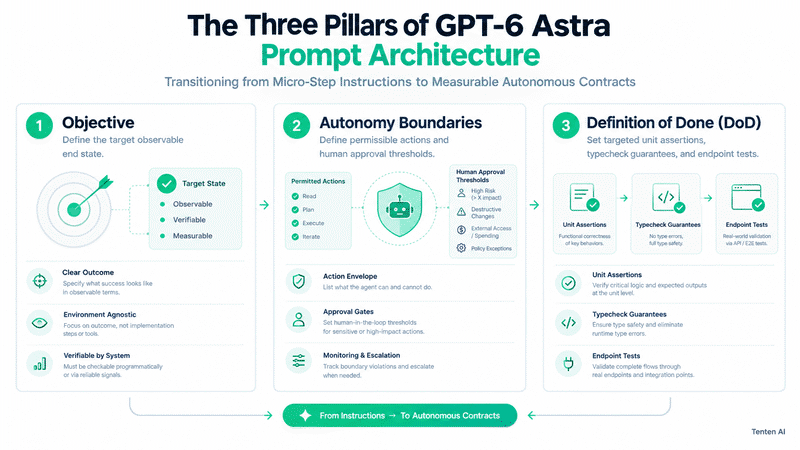
When partnering with advanced autonomous agents, effective prompts do not dictate mechanical steps. Successful engineering execution relies on three fundamental pillars:
- Objective: The observable end state or software artifact required.
- Autonomy Boundaries: The clear operational envelope within which the agent acts independently, alongside specific destructive actions that require engineer confirmation.
- Definition of Done (DoD): Objective verification criteria, such as passing targeted tests, zero typecheck errors, or expected status codes from specific endpoints.
Equipped with a measurable definition of done, GPT-6 Astra leverages its internal reasoning to navigate execution paths efficiently.
Frequently Asked Questions
Why does packing all project rules into AGENTS.md degrade GPT-6 Astra performance?
Massive documentation files consume limited context space and dilute model attention away from code tokens and task specifications. Monolithic files also frequently introduce contradictory instructions, which causes advanced reasoning models to waste tokens resolving competing priorities.
Does progressive disclosure increase agent latency through additional tool invocations?
Empirical testing confirms that progressive disclosure reduces total execution time. While the agent executes an additional read tool call to fetch specific references, starting from a lean context eliminates circular debugging and hallucinated tool calls caused by conflicting instructions.
How can engineering teams maintain code quality without mandatory full-suite test runs?
OpenAI recommends shifting to crisp definitions of done paired with targeted verification. Teams direct the agent to validate affected components with focused unit tests and static type analysis, running complete integration suites only during final pull request gating.
Author Insight
Autonomous agent systems perform best when given autonomy over implementation and strict boundaries on acceptance. In our engineering practice, adding rules to AGENTS.md was our standard reflex whenever an agent stumbled. Yet over-specifying every intermediate action paralyzes frontier models. GPT-6 Astra represents a fundamental shift in AI engineering: replace defensive procedural hand-holding with clean module interfaces, dynamic skill trees, and unambiguous acceptance criteria.
Sources
About the author
Crafting seamless user experiences with a passion for headless CMS, Vercel deployments, and Cloudflare optimization. I'm a Full Stack Developer with expertise in building modern web applications that are blazing fast, secure, and scalable. Let's connect and discuss how I can help you elevate your next project!
Comments
Join the discussionNo comments yet. Be the first to comment.