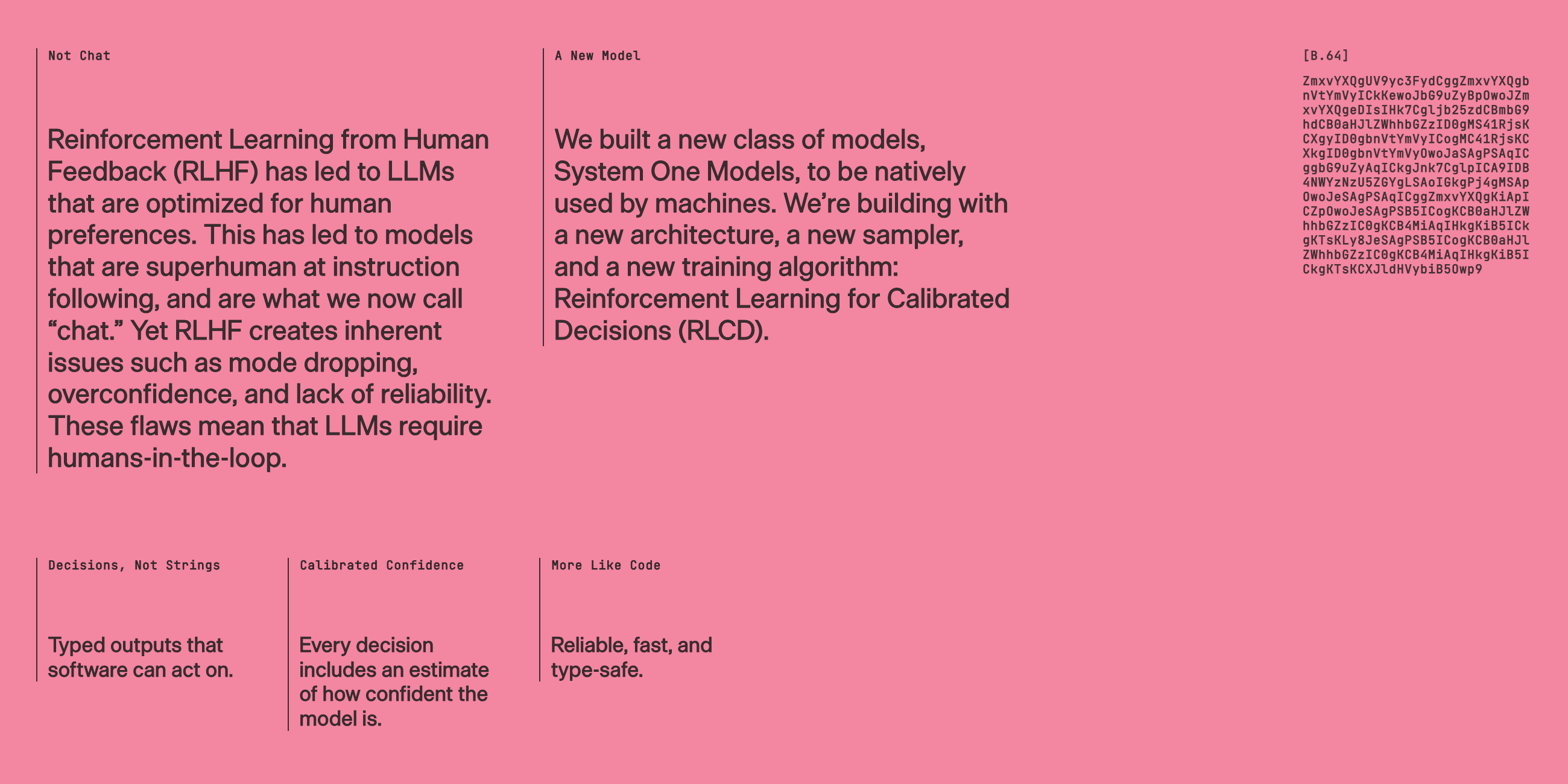
Jev is TypeSafe AI's System One model for turning supplied context into typed decisions that software can use. It entered early access on September 15, 2026. Its three question types cover selection, scoring, and yes-or-no judgments. It does not generate free-form text.
The practical opportunity is a faster decision step inside an existing application. A support system could classify a ticket before calling a writing model. A retrieval pipeline could filter passages before building an answer. Neither workflow requires handing control of the application to Jev.
That distinction matters because a valid answer can still be wrong. Jev can select an allowed department while misunderstanding the customer's problem. Teams evaluating it need to measure the decisions that survive review.

Start with the interface
TypeSafe founder Diogo Almeida describes a model architecture with parallel sampling and Reinforcement Learning for Calibrated Decisions, or RLCD. The training objective targets decision probabilities. These are the vendor's architectural claims; they do not establish reliability for every customer workload.
An API request contains state and questions. State holds the material being evaluated, including relevant policies or records. Questions define the judgments and their permitted outputs. Each question evaluates the same state independently, so the application owns dependencies between answers.
| Primitive | Use it for | Returned fields | Design boundary |
|---|---|---|---|
| Choice | Selecting a support team | choice, probabilities, confidence |
Up to 255 options; include an escape category when needed |
| Score | Rating disruption against a rubric | score, probabilities, confidence |
Describe observable conditions for each level |
| Noul | Asking whether a refund was requested | noul, between 0 and 1 |
No separate confidence field |
For Choice, distinguish the options in their descriptions. A billing category should explain how it differs from delivery or returns. An other option gives the model an allowed answer when the list is incomplete.
Score suits ordered judgments. A bug rubric might distinguish cosmetic damage, broken functionality with a workaround, and work that cannot continue. An intermediate score reflects the distribution across levels. It is not a precise measurement of money or elapsed time.
Noul returns the probability of a yes answer. A value near zero supports no; it does not mean the model lacks confidence. Treating every low number as uncertainty would send clear negative answers into review.
Confidence needs a deployment policy
Choice and Score confidence summarize the shape of their probability distributions. A concentrated distribution generally produces higher confidence. A confidence value of 0.9 is not a promise that this individual answer is 90% likely to be correct.
Set thresholds using labeled examples from the intended workload. A folder assignment and a refund approval have different error costs. They should not inherit one threshold simply because the API exposes one field.
An initial trial can run beside the existing workflow. Store the proposed decision without executing it, then compare it with human handling. Measure how many cases are handled automatically, how often those cases are wrong, and how much review remains. Track rare but costly mistakes separately from routine misclassifications.
Parallel questions also need consistency checks. If two independent answers imply incompatible actions, application code should resolve the conflict or request review. Jev does not turn a collection of independent predictions into a coherent business policy automatically.
What the price and speed numbers establish
On September 21, 2026, TypeSafe's model page listed jev-1.13.0. Both jev-latest and jev-preview resolved to it. The published input price was $0.042 per million tokens, with no output-token charge.
At an assumed 1,000 input tokens per request, one million requests would cost $42 in model input fees. That calculation excludes retries, other model calls, data preparation, and review. Additional questions still consume input tokens, even when batching reduces repeated context and network round trips.
| Published property | Value | Qualification |
|---|---|---|
| Total request budget | 64k tokens | State plus all questions |
| State and longest question | 32k tokens | A separate constraint |
| Vendor response-time range | 70–500 ms | Not a latency guarantee for every location |
| Vendor workflow comparison | 193.6x faster; 444.6x cheaper | Specific workloads and comparison settings |
The headline multipliers come from TypeSafe's workflow evaluations. Their reference answers use the average predictions of larger models rather than universal human-labeled ground truth. An internal capabilities team built the workflows, and TypeSafe acknowledges possible bias. The comparison also uses a structured-decision wrapper that requests probabilities from the competing models.
Those results justify a workload-specific test. They do not establish the same savings against a small classifier or a short structured-output call. Public pricing also does not reveal TypeSafe's margins or prove that the current economics will persist.

Useful applications and their limits
Support triage is a manageable starting point. Ask separately which team should respond and whether the customer requests a refund. A ticket describing both a wrong size and a duplicate charge should retain evidence for both issues. The final routing rule belongs in code.
For moderation, separate potential fraud from abuse or exposed personal information. Route disputed cases to review before irreversible account actions. In recruiting, a bounded extraction task could identify explicitly stated skills. Final hiring decisions require separate scrutiny for errors and bias; a confidence score cannot provide that review.
A retrieval application can ask whether each candidate passage helps answer a query. A writing model then works with the selected evidence. Keep generative models for prose, code generation, and tasks that need extended reasoning.
TypeSafe's Jev 1.13 limitations page, reviewed September 17, lists nine failure categories. They include literal interpretation, numerical precision, date comparisons, indirect reasoning, distracting context, and adversarial content. Conflicting instructions and inconsistent structural judgments are also documented. Generation remains outside the model's intended role.
Keep arithmetic and date ordering in deterministic code. Reduce irrelevant state before asking a question. Validate relationships between outputs and retain timeout handling. A schema guarantee does not remove network failures or authorize an external action.
The current model accepts text, including JSON-shaped state, rather than raw images, audio, or video. English is its primary training language. Teams handling other languages need their own evaluation set, including mixed-language inputs and informal wording.
Implementation entry points
The official Playground lets developers supply state and experiment with question definitions. API access requires an authorized account and key. The HTTP entry point is POST https://api.typesafe.ai/v1/systemone; the Python SDK requires Python 3.10 or later.
pip install typesafe-sdk
The client reads TYPESAFE_API_KEY from the environment. This example uses the documented SDK interface and prints a suggested destination. It has not been tested against the paid API. The 0.8 threshold is illustrative and needs local validation.
from typesafe_sdk import Choice, TypeSafeClient

with TypeSafeClient(model="jev-1.13.0") as client:
    result = client.system_one(
        state="The same order was charged twice. Please check it.",
        questions={
            "team": Choice(
                instructions="Which team should inspect this message first?",
                criteria={
                    "billing": "Charges, invoices, or payment issues",
                    "shipping": "Delivery progress or missing packages",
                    "other": "No category fits, or information is insufficient",
                },
            )
        },
    )
answer = result.answers["team"]
destination = answer.choice if answer.confidence >= 0.8 else "manual_review"
print(destination)
Pinning the model version helps reproduce an evaluation. Recheck thresholds when upgrading, and log the version returned by the API. TypeSafe also provides a JavaScript SDK and an agent skill. Review dependencies and installation scope before adding either to a project.
The early community response
Public discussions from September 16 through September 19 show enthusiasm for fast screening before an expensive generative call. Other participants question whether the new category differs enough from existing classifiers. They also challenge the suggestion that type safety eliminates incorrect decisions.
These are self-selected early reports, with inconsistent workloads and little shared evaluation methodology. They establish useful questions rather than a community consensus. A credible comparison needs the same inputs, output contract, and tolerated error rate. The novelty of the name cannot settle that comparison.
FAQ
Can Jev replace ChatGPT?
Jev does not generate free-form answers, articles, or code. It can handle bounded decisions before or after a generative model call.
Does zero hallucinations mean zero mistakes?
The vendor's guarantee concerns permitted output types and choices. Jev can still select the wrong permitted answer or evaluate incomplete information.
Can I run Jev locally?
The verified official entry points are a hosted API and Playground. This reporting did not establish an official downloadable weights release. Installing the SDK does not install the model.
Does Jev support non-English workflows?
It accepts non-English text, but TypeSafe says English currently performs best. Evaluate the actual language and writing patterns of the intended workload before enabling automatic actions.
Sources
- TypeSafe AI launch and evaluation methodology
- Current model specifications and pricing
- Choice reference
- Score reference
- Noul reference
- Confidence documentation
- Jev 1.13 documented limitations
- Official quick start
Author Insight
I would begin with a routing task that a person can check quickly. Retain the rejected cases and measure the review queue. Cheap inference helps only when the surrounding workflow also becomes cheaper to operate.
About the author
Crafting seamless user experiences with a passion for headless CMS, Vercel deployments, and Cloudflare optimization. I'm a Full Stack Developer with expertise in building modern web applications that are blazing fast, secure, and scalable. Let's connect and discuss how I can help you elevate your next project!
Comments
Join the discussionNo comments yet. Be the first to comment.