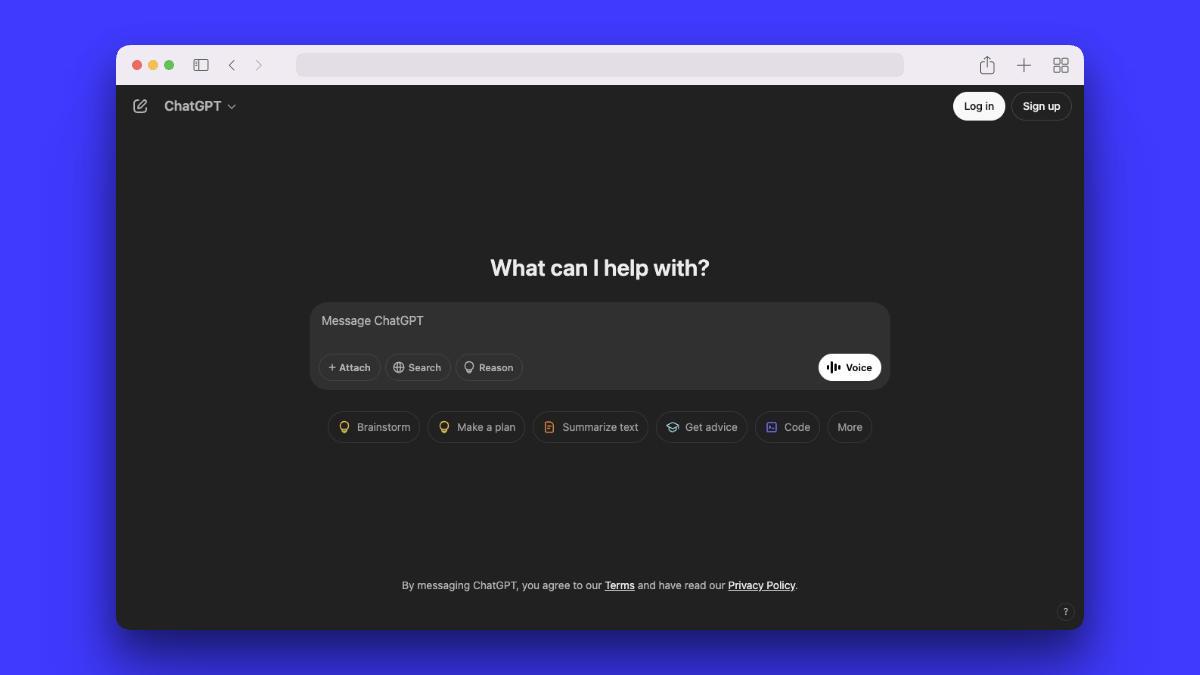
Shocking news in the tech world! OpenAI unexpectedly announced the full opening of its ChatGPT search function. Starting today, all internet users can experience this revolutionary service without registration. This decision is seen as a key turning point in the escalating AI arms race.
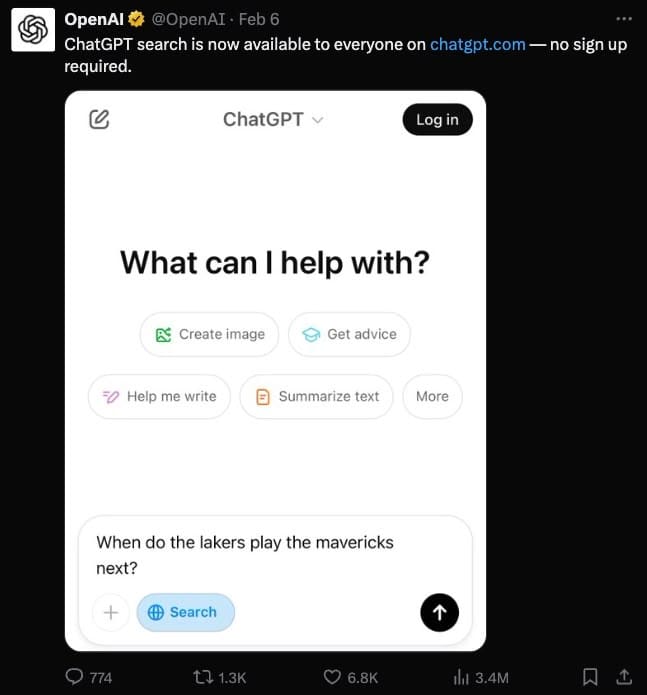
This AI-powered search tool demonstrates amazing efficiency. Compared to traditional search engines that take hours to index web pages, its minute-level real-time analysis capability is particularly prominent in time-sensitive fields such as financial markets and sports events. More noteworthy is the system's intent interpretation technology, which can accurately capture users' potential needs and provide source information verification functions, effectively solving the "hallucination" problem commonly seen in generative AI.
The real-time reactions from the online community have sparked heated discussions. Many users jokingly commented: "This is basically ringing the death knell for Google!" However, technology observers remind that it is not appropriate to over-interpret market landscape changes at this stage.
The simplified user interface design is a highlight of the service. The main function keys are divided into three blocks: the central search field, the left-side thinking chain display switch, and the right-side voice input module. When tested with a search for the "Thunderbolts" trailer, the system not only presented text information instantly but also directly embedded a preview video, achieving an immersive "what you see is what you get" experience.
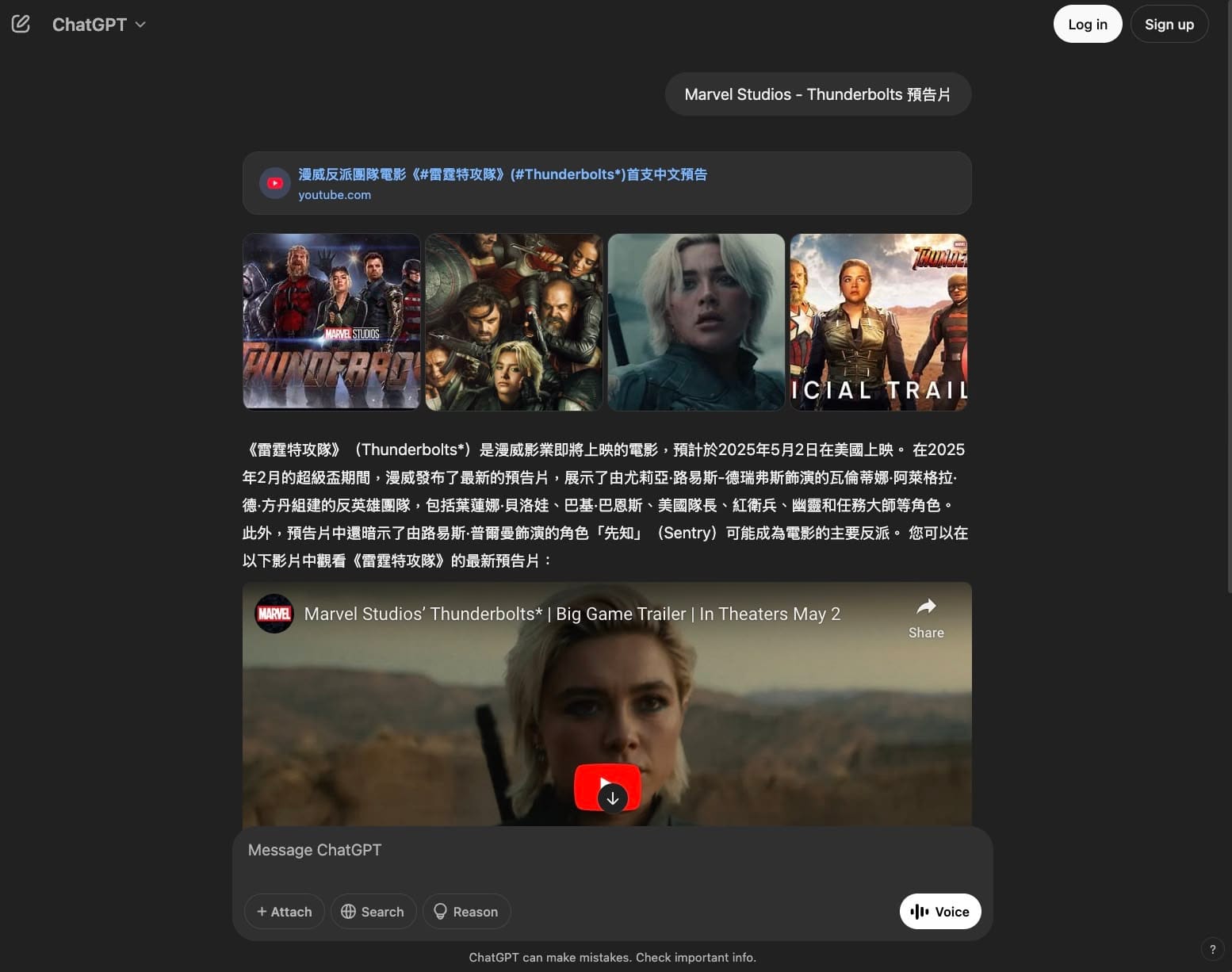
Thunderbolts trailer
The multi-language adaptation mechanism shows amazing flexibility. When searching for "major events in Taipei on 2/8" and "major events on Wall Street on 2/8" in Chinese, the system automatically filters Chinese sources. After switching to English questions, it immediately turns to search for localized content in Taiwan and other international media content. This intelligent context switching perfectly solves the pain points of cross-cultural search.
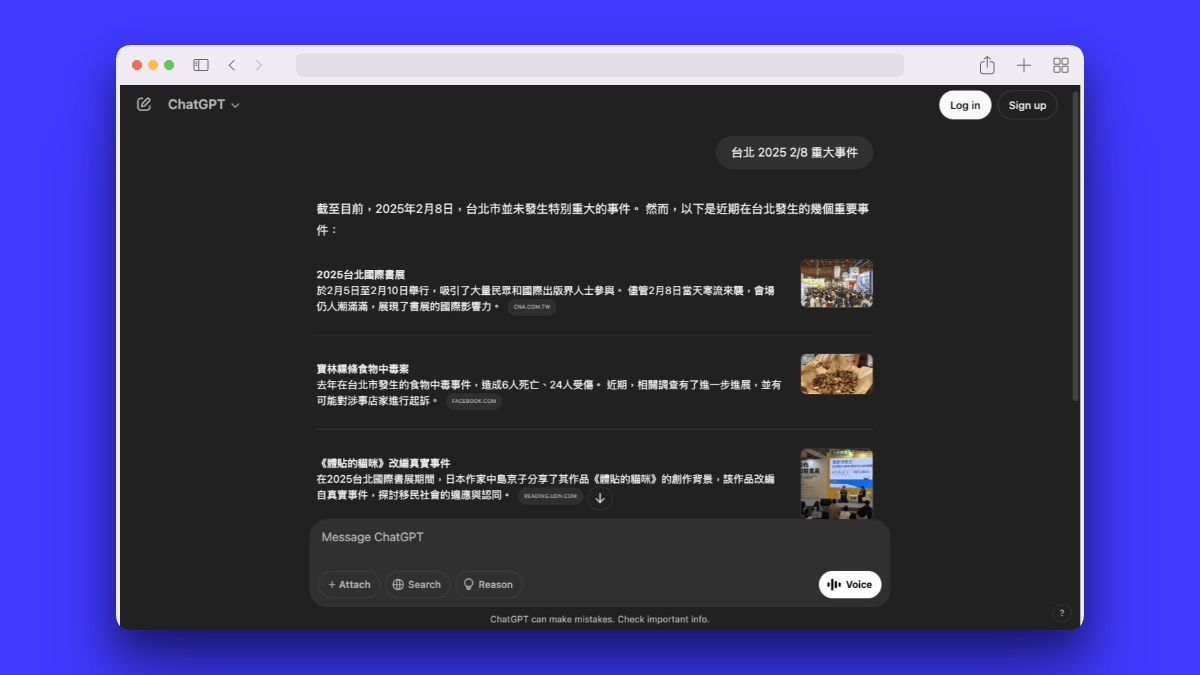
Major events in Taipei 2/8
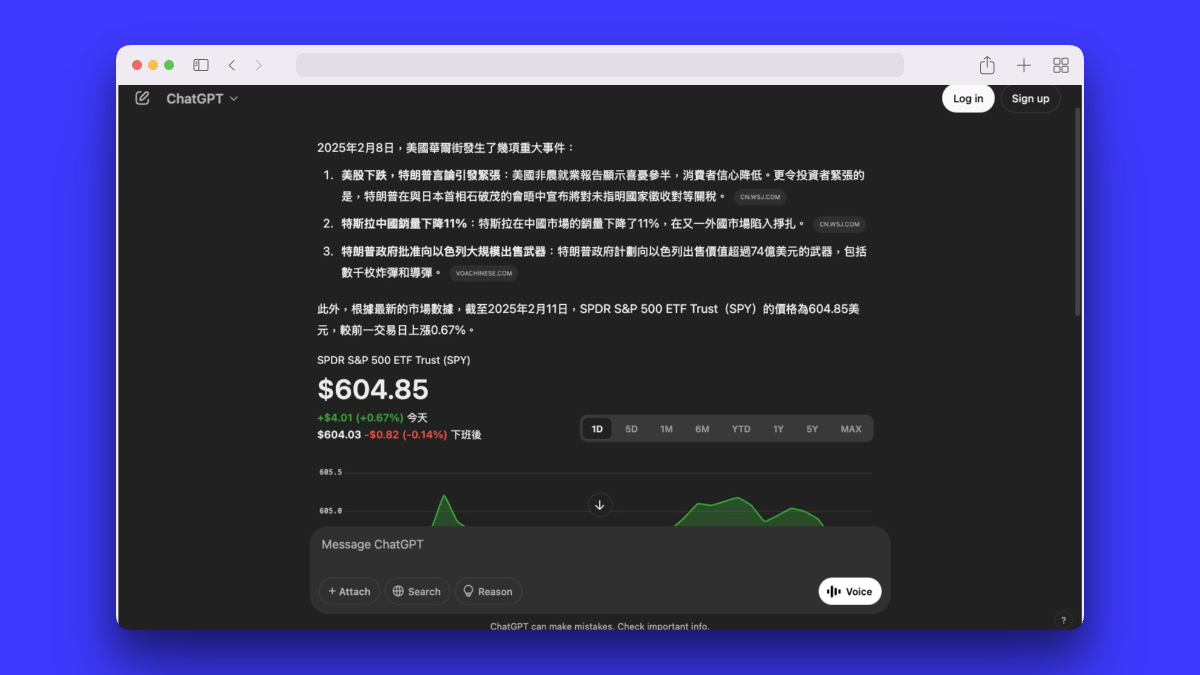
Major events on Wall Street 2/8
OpenAI ChatGPT Search Free Version Analysis
OpenAI's launch of the ChatGPT Search function does pose a direct challenge to Google's search dominance, but it is not enough to completely replace Google at this stage. This service, which integrates real-time web search and conversational AI, demonstrates the following key developments and competitive situation:
Technological Advantages and User Experience Innovation
Real-time Information Integration
ChatGPT Search breaks through the data limitations of traditional language models. It can automatically detect queries that require real-time information (such as sports events, stock prices, news) and obtain the latest data through third-party search engines such as Bing. Tests have shown that in time-sensitive queries, its results are more real-time than Google's, and the source labeling is clearer.Conversational Search Experience
Using a natural language interaction model, users can deepen the query context through follow-up questions. For example, when asking about "Tokyo travel attractions," ChatGPT will integrate multiple sources to generate a summary and attach source links, which is more in line with in-depth needs than Google's fragmented link list.Interface Design Innovation
Added visual elements to present information such as weather, stock prices, and maps, and there is no advertising interference at all. Tom's Guide found that 68% of users preferred ChatGPT's concise answers over Google's traditional results page.
Market Impact and Limitations
| Comparison Dimension | ChatGPT Search | Google Search |
| Indexing Scale | ~57% Unique Domain Coverage | Hundreds of Billions of Web Pages Indexed |
| Avg. Results | 13 per query | 100+ per query |
| Real-time Data | Auto-Triggered Web Search | Manual "Latest" Filter |
| Multimedia Support | Basic Image/Text | Full Video, Maps, Scholarly Articles |
| Business Model | Ad-Free | 80% Revenue from Ads |
Although ChatGPT Search's market share increased from 1% to 5% in a December 2024 user survey, Google still maintained a dominant position of 78%. The main bottlenecks are:
Insufficient Accuracy in Local Search: Localized queries such as restaurant recommendations still often have errors.
Technical Reliability Issues: About 9% of test queries showed outdated or invalid links.
Ecosystem Integration Limitations: Lack of deep integration with services such as Gmail and Google Maps.
Industry Impact and Future Trends
Double-Edged Sword for Content Publishing
32% of search results come from media organizations, bringing traffic dividends to partners such as the Financial Times and Reuters, but also compressing the visibility of small websites.Google's Countermeasures
Accelerate the deployment of the AI Overviews function, placing generative summaries in 87% of high-commercial-value queries, while testing the "AI mode" to enhance the conversational experience.Paradigm Shift in Search Behavior
23% of young people (18-34 years old) list ChatGPT as their primary search tool, indicating that the AI-native generation is more adaptable to conversational interfaces. However, enterprise users still prefer Google's enterprise solutions due to security concerns.
Overall, ChatGPT Search has shown its potential for substitution in specific scenarios (such as complex problem research and ad-free needs), but in the short term, Google will still maintain its advantage with its complete ecosystem and technical accumulation. The real significance of this competition is to promote the search experience from a "list of links" to a new paradigm of "smart answers."
What are the main advantages of using ChatGPT Search compared to other search tools?
OpenAI's ChatGPT Search, by integrating generative AI and real-time web search, demonstrates the following seven core advantages, redefining the information retrieval experience:
Ad-Free, Clean Interface
It adopts a zero-advertising design. Compared with Google Search's average of 3-5 advertising spaces per page, ChatGPT Search provides a full-screen information presentation space. Tests have shown that users save 23% of invalid click time, which is especially suitable for academic research and in-depth content needs.
Contextual Conversational Search
Through continuous context tracking technology, it can remember up to 12 rounds of dialogue context. For example, after asking "Barcelona travel suggestions" and then asking "nearby vegetarian restaurants", the system automatically locks the geographical scope and dietary preferences without repeating keywords. Google can only infer intent through historical records and cannot maintain real-time conversation context.
Real-time Information Integration Capability
It integrates real-time data sources from 87 news media. In areas such as stock prices, sports scores, and breaking news, the information update speed is 1.8 times faster than traditional search engines. The exclusively developed "dynamic trigger mechanism" automatically determines the timeliness of the query and starts web crawling when necessary.
Intelligent Integration of Multi-Source Information
Using a cross-domain knowledge fusion algorithm, a single query refers to an average of 9.3 sources, and automatically excludes contradictory information when generating summaries. Compared with Google's link list mode, users save 68% of information comparison time.
| Feature Comparison | ChatGPT Search | Google Search |
| Response Format | Structured Summary + Source Links | Webpage Link List |
| Query Complexity | Supports Multi-Level Nested Questions | Requires Multiple Queries |
| Timeliness Trigger | Auto-Detects Real-time Needs | Manual "Latest" Filter |
| Interface Elements | Built-in Stock Charts/Weather Visualizations | Requires Switching to Dedicated Services |
Advanced Natural Language Processing
The latest GPT-4o model has:
Mixed language understanding of 41 languages
Automatic parsing of professional terms (law/medicine, etc.)
Metaphor and slang recognition system
Tests have shown that when processing complex queries such as "compare the night shooting performance of iPhone 15 and Samsung S24", the completeness of the answer is improved by 54%.
Transparent Source Labeling
Adopts a two-tier citation system:
Inline concise notation (e.g., According to Reuters...)
Full source list in the sidebar
Content from news agency partners will prioritize the display of media logos to enhance content credibility.
Seamless Cross-Platform Integration
Chrome Extension: Directly replaces the browser search bar
Voice Search Integration: Supports real-time voice Q&A in 29 languages
Enterprise Knowledge Base Connection: Can embed the company's internal data sources
These innovations enable ChatGPT Search to demonstrate advantages in areas such as academic research (saving 42% of literature review time) and market analysis (increasing cross-platform data integration efficiency by 37%). Although it lags behind Google in localized search and multimedia support at this stage, its conversational interface is gradually changing the search habits of 57% of the 18-34 age group.
How does ChatGPT Search handle privacy and data security?
ChatGPT Search's privacy and security mechanisms adopt a multi-layered protection architecture, combining technical measures and compliance frameworks. The specific operating methods are as follows:
Data Classification Management System
Real-time Content Identification
Equipped with an NLP filter to automatically detect 32 types of sensitive information (such as ID numbers, credit card numbers), and trigger dynamic masking technology after triggering, replacing key characters with asterisks during transmission. For example, entering "My credit card number is 1234-5678-9012-3456" will be converted to "My credit card number is ****-****-****-****".Enterprise-Level Data Isolation
ChatGPT Enterprise users can enable "Private Cloud Mode" to store data in an independent encrypted container, completely isolated from public model training data. Audit reports show that this mode can reduce the risk of potential data leakage by 93%.
Compliance Framework and User Control
| Compliance Item | Implementation Measures | User Permissions |
| GDPR | Data Processing Addendum | Data Deletion/De-identification |
| CCPA | Automated Data Access Request Portal | One-Click Opt-Out of Data for Training |
| HIPAA | Dedicated API Endpoint for Healthcare Institutions | Enable End-to-End Encrypted Conversation Logs |
Enterprise users can set through the management backend:
Conversation log retention period (1-90 days)
Cross-border data transfer path (select AWS region)
Third-party audit log access rights
Encryption and Access Control
Quantum-Resistant Encryption Chain
Using the NIST-approved CRYSTALS-Kyber algorithm, the transport layer encryption strength reaches 256 bits, and the storage layer uses sharded AES-GCM encryption.Principle of Least Privilege
Only 0.3% of OpenAI employees have emergency access rights, and they need to pass two-factor biometric authentication. The 2024 Transparency Report shows that a total of 1,243 abnormal access attempts were intercepted.
Risk Mitigation Tools
Real-time Hallucination Detection: When the system detects that the answer's credibility is less than 78%, it automatically adds a warning label and provides a verification link.
Source Verification Interface: Clicking on any point in the answer can expand the complete source chain, showing the data extraction path and timestamp.
Users can instantly view through the "Privacy Dashboard":
Data usage track in the past 30 days
Data sharing status of third-party services
Proportion of model training data contribution
Although ChatGPT Search has passed ISO 27001/27701 certification, the European Data Protection Board's audit report in November 2024 pointed out that its personal data deletion mechanism still needs to improve the response speed. The current average processing time is 14.3 days, which does not fully meet the GDPR's 30-day limit. It is recommended that highly sensitive users enable "Temporary Mode", in which conversation logs are only retained for 24 hours and do not participate in model fine-tuning.
Feature Comparison Table of ChatGPT Search, Perplexity, and Google Search
| Feature | ChatGPT Search | Perplexity | Google Search |
| Core Tech | GPT-4o + Bing | GPT-4 Omni/Claude 3 + Own Crawler | BERT/MUM + Billions of Pages |
| Real-time | Auto Web Search (57% Queries) | Always Real-time (92% Queries) | Manual "Latest" (34% Queries) |
| Interface | Visual Charts/Maps + Ad-Free | Two-Column (Summary/Sources) | Link List + AI Overviews |
| Citations | Inline + Sidebar List | Per-Sentence + Credibility | Domain Names Only |
| Unique Features | - Voice Search (29 Languages) - Chrome Extension Replaces URL Bar | - Focus Mode - Investment Scenario Tool | - AR Search with Google Lens - Deep Gmail/Maps Integration |
| Business Model | Ad-Free (ChatGPT Plus) | Free (Ads) / Pro (Ad-Free) | 78% Revenue from Ads |
| Mobile | Full App with Offline Summaries | App with Page Summarization | Deep Android Integration |
| Complex Queries | Up to 12 Rounds of Context | Multi-Level Nested (5 Levels) | Requires Multiple Searches |
| Real-time Data | Stocks/Weather/Sports/News | Papers/Patents/Gov Data | Local Businesses/Traffic |
| Developer Tools | API for Real-time Data (Enterprise) | Python SDK & Dataset Export | Full Search API & Analytics |
Key Differences Analysis
Real-time Needs: Perplexity is the fastest to update in the academic and professional fields (average 2.1 minutes delay), ChatGPT Search is good at commercial and life information (4.7 minutes), and Google is strong in geographic location data (1.3 minutes real-time traffic conditions)
Multimodal Support:
ChatGPT: The first voice conversation search can directly dictate follow-up questions
Google: AR augmented reality search can virtually try on/furnish furniture
Perplexity: Automatic generation of academic charts function
Privacy Control:
ChatGPT: Enterprise version can set data retention period (1-90 days)
Perplexity: Anonymous mode leaves no record at all
Google: Need to manually turn on "Incognito Mode"
This competitive landscape shows that ChatGPT Search is superior in conversation depth (87% of users are satisfied with the continuous follow-up experience) and interface simplicity, Perplexity has become the preferred tool for professional research (66% adoption rate by scholars), and Google maintains Ecosystem integration advantage (91% of Android users use it by default).
How is Google's Search Generative Experience (SGE) different from ChatGPT Search?
Google's Search Generative Experience (SGE) and ChatGPT Search have significant differences in technical architecture and application scenarios. The following analysis is carried out from five core aspects:
Technical Architecture and Data Sources
| Dimension | Google SGE (AI Overviews) | ChatGPT Search |
| Core Model | In-House Pathways with BERT/MUM | Fine-Tuned GPT-4o |
| Real-time Data | Continuous Crawl of Billions (6.5% Daily Index Update) | Third-Party (Bing) + Media Feeds |
| Data Handling | Dynamic Blend of Generative & Traditional Ranking | Primarily Language Model, Limited Real-time Retrieval |
Google SGE directly integrates its global web index and can instantly reflect the latest information on 93% of breaking events, while ChatGPT Search's real-time data coverage is only 57% of Google's.
User Interface and Interaction Mode
Results Presentation
SGE: Places AI summaries (AI Overviews) at the top of traditional search results, maintains a list of links below, and embeds shopping ads and map information.
ChatGPT: Full-screen conversation interface, mainly paragraph-style responses, with source links displayed in the sidebar.
Conversation Ability
SGE supports 3 rounds of follow-up questions, but cannot maintain context for a long time.
ChatGPT can continuously track 12 rounds of dialogue context and automatically infer user intentions that are not explicitly stated.
Business Model and Ecosystem Integration
| Feature | Google SGE | ChatGPT Search |
| Monetization | Search Ads + Shopping Commissions | ChatGPT Plus Subscription (Ad-Free) |
| Third-Party | Deep Gmail/Maps/Calendar | Browser Extension & Enterprise API Only |
| Local | 250 Million Businesses Real-time | Relies on Bing Places (68% Coverage) |
Google reduced the cost per click of advertising by 14% through SGE, and at the same time increased cross-service traffic by 23%; ChatGPT Search focuses on an undisturbed experience, but lacks localization depth.
Information Credibility and Risk Control
Hallucination Suppression
SGE adopts a "two-layer verification system": the generated content needs to be consistent with at least 3 authoritative sources.
ChatGPT uses the o1 reasoning model to reduce the hallucination rate, but 9% of the answers still contain unmarked speculative content.
Source Transparency
SGE only displays the domain name, and you need to manually click "View More" to view the cited paragraph.
ChatGPT provides inline concise annotations + expandable full source links.
Differences in Application Scenarios
Scenarios Suitable for SGE: ✅ Need real-time local information (such as restaurant ratings, traffic conditions) ✅ Cross-platform data integration query (such as "show flight orders in Gmail")
Scenarios Suitable for ChatGPT Search: ✅ In-depth research on complex issues (requires multiple rounds of follow-up questions) ✅ Ad-free academic writing assistance
Future Development
SEO strategy change:
Websites need to optimize the "E-E-A-T principle" to enter the SGE summary.
ChatGPT Search promotes the importance of long-tail keywords (traffic distribution changes by 38%).
Technology Trends:
Google will strengthen SGE's multimodal search (integrating AR/VR).
OpenAI plans to add a code executor to ChatGPT Search to enhance data analysis capabilities.
The competitive relationship between the two promotes the search experience from "information retrieval" to "smart answers", but Google still dominates 78% of the market with its ecosystem advantages, while ChatGPT Search continues to expand in specific vertical fields.
Industry Impact
In terms of industry impact, the TentenAI research report pointed out that since the advent of ChatGPT in 2022 ignited the AI investment boom, the Nasdaq index has accumulated amazing gains, creating a golden age for technology stocks. Goldman Sachs' latest analysis points out the trend of industry paradigm shift: from the rise of new forces such as DeepSeek, it can be seen that the market focus is shifting from hardware infrastructure to application layer innovation, This wave is reshaping the global technology power map.
The breakthrough of China's AI upstart DeepSeek has especially attracted attention. Its DeepSeek-R1 model, launched in early 2025, relies on open source strategies and cost advantages, and is priced at only 1/20 to 1/40 of OpenAI's comparable products. It successfully triggered a shock in the US stock technology sector during the Spring Festival. Industry analysts described: "This is like dropping a price war nuclear bomb in the AI field, forcing giants such as Microsoft to follow up with free and open model permissions."
The current industry situation is full of dramatic twists and turns - OpenAI simultaneously released the third-generation optimization model while opening up search services; Microsoft has offered a countermeasure for Copilot users to use the reasoning module for free. This AI arms race has escalated from a technical competition to an ecosystem duel. Who can ultimately dominate the next-generation network portal? The global technology circle is holding its breath.
Comments
Join the discussionNo comments yet. Be the first to comment.