Cursor Origin Wants the Agent Workflow. Keep GitHub During the Beta.

Crafting seamless user experiences with a passion for headless CMS, Vercel deployments, and Cloudflare optimization. I'm a Full Stack Developer with expertise in building modern web applications that are blazing fast, secure, and scalable. Let's connect and discuss how I can help you elevate your next project!
Cursor Origin entered early beta on August 17, 2026, bringing Git hosting, pull requests, code browsing, and cloud agents into Cursor. It can host a repository or sync one from GitHub. GitHub stays the source of truth in sync mode. Origin is worth a pilot, but its safest adoption path keeps GitHub in place while a team measures governance, CI behavior, and recovery.

The safest Origin trial is a mirror, not a migration
A Git forge combines repositories, permissions, pull requests, review, and connected services. Origin moves that surface into the same product where Cursor users assign agents and inspect their work.
Teams have two adoption paths.
| Path | Code location | Source of truth | Best fit |
|---|---|---|---|
| Origin-hosted repository | Cursor Origin | Origin | New projects and low-risk internal tools |
| GitHub-synced repository | GitHub plus an Origin copy | GitHub | Existing projects with Actions, apps, and mature governance |
For a synced repository, pushes return to GitHub. Pull-request comments, replies, and reactions synchronize both ways. That design lets a team test Cursor as the working surface without moving the authoritative repository.
GitHub is also building for agents. Its cloud coding agent can make changes and open pull requests. GitHub supports third-party agents from Anthropic and OpenAI, and Agentic Workflows can compile natural-language workflow definitions into GitHub Actions. Origin's advantage is tighter integration with Cursor, not exclusive access to agent-driven development.
Start an Origin pilot from the command line
Use a low-risk GitHub repository for evaluation. Reserve an Origin-hosted repository for a new project or a deliberate migration test.
The official CLI setup is short:
curl -fsSL https://downloads.cursor.com/origin/install.sh | sh
origin auth login
Clone an Origin-hosted repository:
git clone https://origin.cursor.com/acme/checkout.git
Or add Origin to an existing local project:
git remote add origin https://origin.cursor.com/{owner}/{repo}.git
git push -u origin main
Organizations that prohibit pipe-to-shell installers should download and review the script first. An official one-liner does not replace a software supply-chain policy.
Cloud agents need a reproducible environment
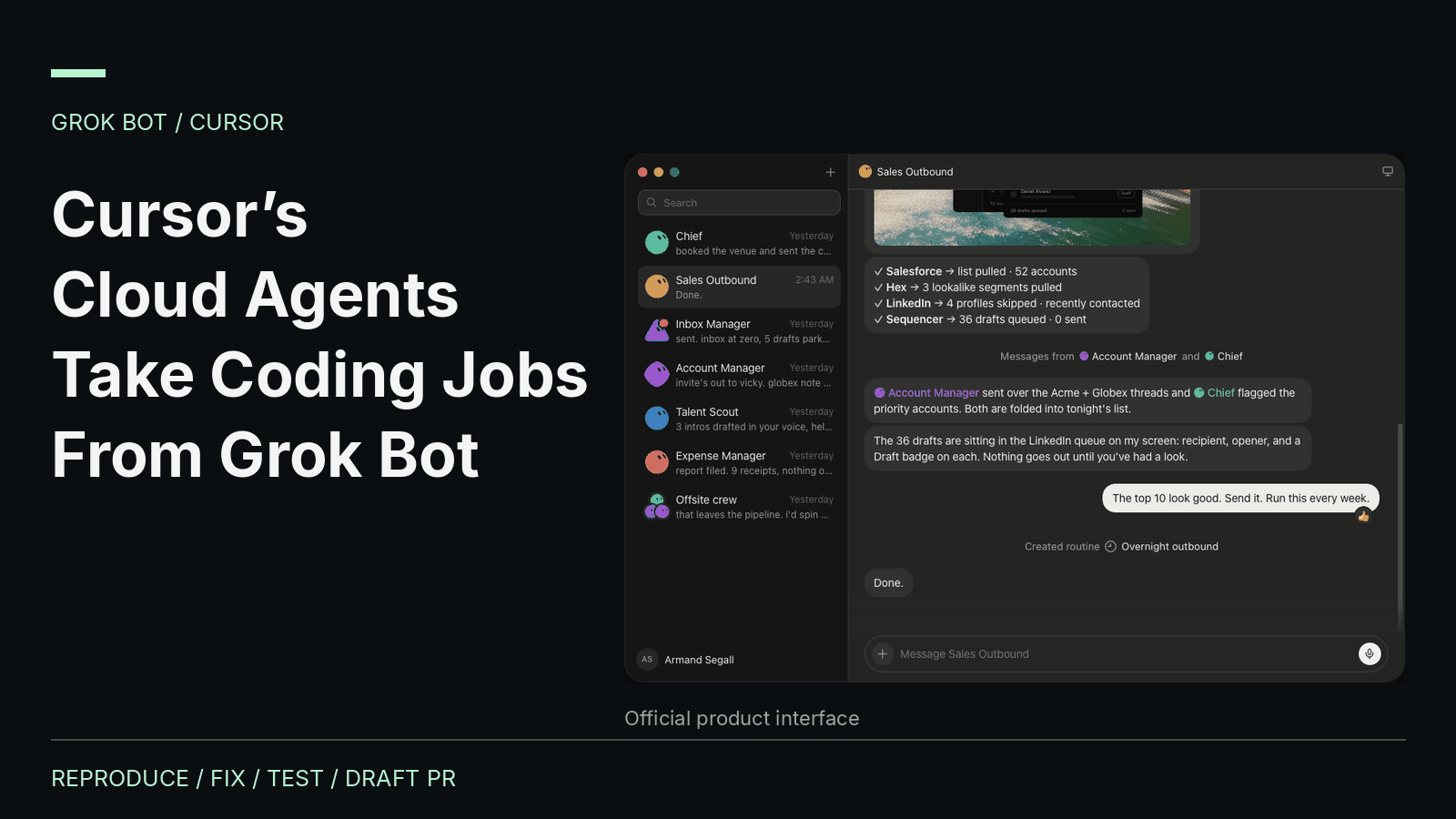
Cursor Cloud Agents run on isolated Ubuntu machines. Cursor offers two setup routes: let an agent inspect the repository and create the environment, or commit a Dockerfile with .cursor/environment.json. Cursor recommends the agent-driven route for initial setup and says it usually takes less than 10 minutes. A committed configuration is easier to review and reproduce.
A minimal environment file can reference a saved snapshot and an install command:
{
  "snapshot": "snapshot-...",
  "install": "npm install"
}
The install step must be idempotent. Store secrets in Cursor's environment settings rather than the repository. Cloud Agent Builds use a 24-hour staleness threshold by default. Setting the threshold to 0 forces a fresh pull for every build, trading startup time for currency.
Put project skills in the repository
A skill installed only on a developer's laptop does not appear in a remote agent environment. Commit project skills under .cursor/skills/ or .agents/skills/ so local and cloud agents discover the same instructions.
.cursor/
  skills/
    release-audit/
      SKILL.md
Versioning a skill is better than pasting a long prompt into every task. Review it like executable workflow code. A small instruction change can alter which files an agent reads, which commands it runs, and what it considers complete.
The beta still carries hard limits
Origin already covers repositories, pull requests, search, and a small set of app integrations. Several beta constraints should keep mature teams cautious.
| Area | Official status in August 2026 | Operational consequence |
|---|---|---|
| Availability | Pro, Teams, and Enterprise; no free-plan beta | Long trials require a paid workspace |
| Repository naming | A codebase name cannot be changed during beta | Naming mistakes create migration work |
| Branch controls | The settings interface is being redesigned | Test every required check and merge rule |
| Apps | Three early integrations: Vercel, Depot, Buildkite | GitHub Marketplace apps have no automatic equivalent |
| API limit | 600 points per minute for user or team keys | Agent concurrency needs a request budget |
| Installation token limit | 3,000 points per minute | Automation must back off before retries multiply |
| App JWT limit | 6,000 points per minute | Large installations still need rate-aware queues |
| API stability | Early beta with breaking changes | Pin assumptions and watch the changelog |
Repository transitions can also create read-only states. Treat an API 403 as an authoritative stop signal. Blind agent retries can turn a controlled transition into a rate-limit incident.
A seven-day pilot should test failure, not just the happy path
Keep GitHub, the current CI provider, and the existing secrets manager. Give Origin one low-risk workflow for seven days.
| Stage | Test | Pass condition |
|---|---|---|
| Day 0 | Permissions, branch rules, secrets | The agent receives only task-level access |
| Days 1-2 | Bidirectional PR interactions | Comments and state match without loss or duplication |
| Days 3-4 | Vercel preview or current CI | The same commit SHA maps to the same checks and artifacts |
| Day 5 | GitHub or Origin interruption | Read, write, queue, and recovery ownership is documented |
| Days 6-7 | Delivery metrics | Review time, failed reruns, and lead time do not regress |
Track agent attempts and CI jobs per merged change as well. Agent activity can rise sharply while throughput stays flat. The merge is the useful unit, not the number of generated branches or comments.
Who should use Origin now
Small teams, new projects, and heavy Cursor Cloud Agent users have the clearest reason to test Origin. Projects that depend on complex branch protection, GitHub Apps, audit exports, or public collaboration should start with sync mode.
Origin also reduces confusion between local and cloud work for non-developers. The setup still requires Git concepts such as remotes, branches, pull requests, and execution environments. The path is shorter. The underlying model remains technical.
Frequently asked questions
Can Cursor Origin replace GitHub today?
A full replacement is hard to justify during the early beta. Origin handles repositories, pull requests, cloud agents, and several integrations. GitHub still has broader governance, app coverage, public collaboration, and operational history.
Can I try Origin without moving a GitHub repository?
Yes. Sync the existing repository and keep GitHub as the source of truth. Origin maintains a current copy while pushes and pull-request interactions write back to GitHub.
Which CI and deployment integrations does Origin support?
The first integrations are Vercel, Depot, and Buildkite. Synced repositories can keep CI on GitHub. Origin-hosted repositories can use Depot or Buildkite to run existing GitHub Actions workflows, while Buildkite also supports native pipelines.
How do cloud agents access custom skills?
Commit the skills under .cursor/skills/ or .agents/skills/. Project-level skills travel with the repository; skills installed only on a local machine do not.
Is the Origin API ready for production automation?
It is usable for controlled pilots. Production automation should handle rate limits, read-only transitions, 403 responses, and breaking API changes before agents create or retry work at scale.
Sources
- Cursor Origin official landing page
- Cursor Origin launch changelog
- Cursor Origin documentation
- Cursor Origin Git documentation
- Cursor Cloud Agent environment setup
- Cursor Skills documentation
- Cursor Origin API documentation
- GitHub third-party coding agents
- GitHub Agentic Workflows
Author Insight
I would not judge Origin by the number of GitHub tabs it removes. The better measures are agent attempts, human review minutes, CI jobs, failed reruns, and lead time per merged change. If those five numbers do not improve, the control plane has moved without improving delivery.