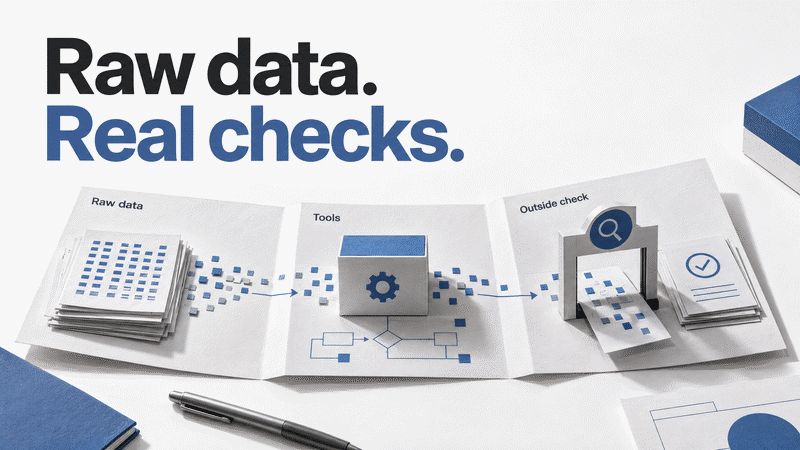
Claude's engineering lead puts raw data ahead of expert role-play
Crafting seamless user experiences with a passion for headless CMS, Vercel deployments, and Cloudflare optimization. I'm a Full Stack Developer with expertise in building modern web applications that are blazing fast, secure, and scalable. Let's connect and discuss how I can help you elevate your next project!
In Felix Rieseberg's October 13, 2026 Claude guide, speed means faster work, altitude targets outcomes, depth uses raw data and expert methods, and range borrows cross-disciplinary methods. His tutorial for humans working with models gives speed its familiar place, then concentrates on altitude, depth and range. For agent builders, the useful question is what an expanded task needs to become executable and verifiable.
A request for a better slide deck can end when the file exists. A request to detect business trouble earlier needs a continuing source of data and a test of whether the warnings helped. That change reaches beyond prompt wording. Somebody has to connect the tools, preserve the evidence and define the result the agent is supposed to leave behind.
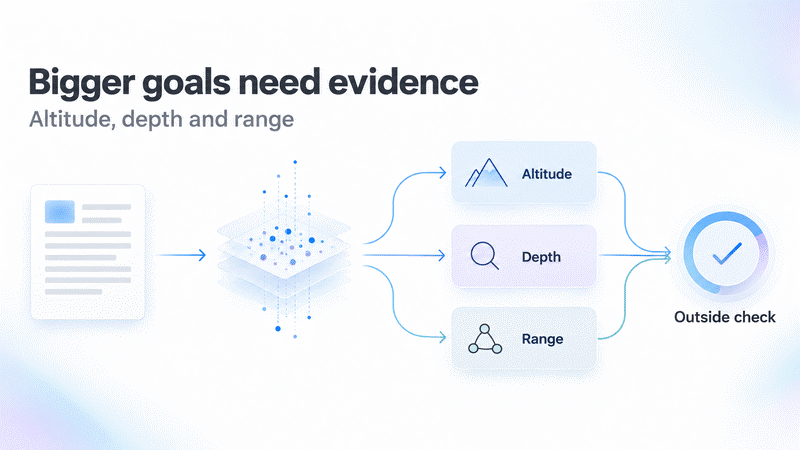
Altitude changes the result an agent works toward
Altitude means moving up a level of abstraction toward the outcome behind an assigned task. Rieseberg develops the idea through a quarterly business review, or QBR, at the fictional company Acme.
The first request asks for an explanation of the business, rather than another pass through a slide template:
Tell me what changed this quarter, why, and what we should do about it.
The next request makes the intended decisions explicit:
Work out which three decisions are most urgent in the face of everything you've learned, and start working on potential directions with for/against arguments.
The third request questions whether the existing review process is the right mechanism at all:
The review exists so leadership catches problems early and moves money and people to the right places. Design a better way to do that than a quarterly deck, show from our own history that it would have caught things sooner, and run it beside the current one for a quarter.
The parallel quarter is part of the example's requested experiment. Rieseberg does not report a measured improvement from an actual deployment at Acme. An implementation would need timestamped alerts, the information available when each alert fired, and the eventual event. A retrospective test that quietly uses later information can make an ineffective warning system look prescient.
Rieseberg offers a separate engineering example from his work: progressing from fixing individual crashes to asking Claude to keep applications crash-free. He first had to supply crash reports, map app versions to Git commits and provide Windows, macOS and Linux environments. Those details explain why a broader goal can become useful. The agent has a path to reproduce a failure and check its fix.
Depth reaches the raw material and the methods
Depth means using the instruments and techniques a leading practitioner would use on the problem. Asking a model to act like a professional can produce a vocabulary change without a change in method.
Rieseberg starts with expert instruments, such as databases and statistical models, then raises the target and challenges the accepted explanation. His loading-time example moves from a proposed reduction of 10 seconds to 5 seconds toward a request for 200 milliseconds. These are illustrative targets, not measured performance. A developer would still need to specify the metric, device and network conditions before treating the number as an acceptance test.
His churn example first asks the model to reproduce a belief from primary data:
We believe churn is an onboarding problem. Try to reproduce that from the raw data.
The next prompt asks for a new signal and retains an explicit unseen-data requirement:
Build a simulation of our customers that reproduces the last year from our logs. Then find the earliest signal of churn we don't know about yet, and show it predicts on data it has not seen.
A simulator that reproduces last year may simply fit the past well. For a usable churn signal, split development and validation data by time and check whether the signal was available before the customer left. A predictive signal also does not establish that an intervention prevents churn. That is a separate question about the effect of an action.
Rieseberg ends the depth sequence by insisting on an outside judge. His reusable prompt preserves four questions before it asks the model to rewrite the assignment:
I want a deeper version of this task, not a bigger one. Before rewriting it: (1) say what a top professional in this field would do here that I'm not asking for; (2) name the rawest material they would start from instead of what has already been digested for me; (3) name the specific methods and tools they would use; (4) say what, other than you or me, would show the result is right. Then rewrite my prompt to ask for exactly that.
The prompt is useful because it exposes missing work before asking for more output. An answer naming a database, a statistical method and a test can be examined. An answer promising expert-level insight gives the builder much less to implement.
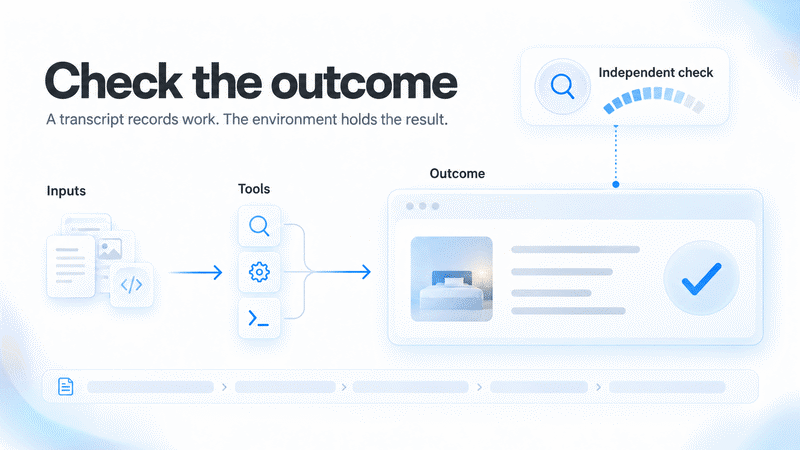
Outside validation checks the environment after execution
Outside validation needs a result that can be checked independently of the agent's completion message. Anthropic's January 9, 2026 article on evaluating AI agents distinguishes a transcript from an outcome. A booking agent can say it reserved a flight; the outcome is whether the reservation actually exists in the database.
Anthropic suggests starting with 20–50 simple tasks drawn from real failures. The recommendation concerns early development, where changes can have large, visible effects. Mature agents may need larger and harder test sets to reveal smaller differences. It is not a universal sample-size guarantee.
The article identifies three grader types: code-based, model-based and human. Choose the grader for the evidence available. A failing test or a missing database record can settle some questions directly; a qualitative assessment may require a rubric and human calibration.
| Work being evaluated | Evidence to retain | Question the evidence can answer |
|---|---|---|
| Crash repair | Reproduction, patched version, test result | Did the original failure disappear? |
| Churn prediction | Time-based split and held-out predictions | Does the signal predict unseen data? |
| Early warning | Alert time, then-available data, later event | Did a useful warning precede the problem? |
The table describes implementation checks, with no claimed performance results. A stable set of tasks can also track latency, token usage and cost per task. If extra agent turns increase expense without improving independently checked outcomes, the case for more computation is weak.
OpenAI's evaluation guide, checked October 16, 2026, offers a comparable three-step process: describe the task, run test inputs, then analyze results and iterate. The method can survive a change of vendor. The same page announces that the Evals platform becomes read-only on October 31, 2026, with shutdown scheduled for November 30, 2026. Builders should separate their evaluation data and criteria from that platform's lifetime.
Range assigns different methods to different questions
Range means bringing in techniques from fields beyond the one immediately associated with a task. Rieseberg starts by replacing a noun with verbs: a deck becomes helping busy people understand a causal account and decide under uncertainty.
That description suggests useful work for an analyst, a journalist and an editor. Presentation requirements might add motion and audio design. An adversarial review might borrow the investigative methods of a short seller or forensic accountant. The value comes from the work performed: checking data, finding gaps and testing the story's claims. Having several agents imitate job titles can add conversation without improving evidence.
Range does not require a multi-agent deployment for every task. Anthropic's December 19, 2024 guide to building effective agents recommends the simplest solution that works, with complexity added when needed. Agentic systems often exchange latency and cost for better task performance. A single model call with retrieval and examples may already be sufficient.
Rieseberg also says these forms of ambition need a computer that can install software and access relevant data. Model Context Protocol, or MCP, is one way to connect tools and data, with other approaches available. A builder can expand the goal while keeping execution rights narrow: begin with analysis and proposed changes, then widen authority when verified results justify it. Task scope and action permissions are separate design decisions.
FAQ
Can Claude's altitude, depth and range apply to one task?
Claude's altitude, depth and range can apply to the same task. Rieseberg's QBR example raises the desired outcome, examines the raw data and brings in methods from other fields. Speed is the fourth dimension. Each expansion still needs a checkable success condition.
Does the Claude ambition guide require Claude?
The Claude ambition guide is not model-specific, according to Rieseberg. The practical requirements are access to relevant data, suitable tools and outside validation. Available connectors and execution features vary by product.
Do Claude agent evaluations require a model grader?
Claude agent evaluations can use code-based, model-based or human graders. Anthropic describes all three types, with the choice depending on what is being judged. Executable tests and database checks can verify some outcomes directly.
Is OpenAI Evals a lasting dependency for a new workflow?
OpenAI Evals has an announced retirement schedule. As of October 16, 2026, its documentation says the platform becomes read-only on October 31, 2026, and closes on November 30, 2026. Keep evaluation inputs and success criteria in a portable format.
Sources
- Felix Rieseberg: How to be more ambitious, October 13, 2026
- Anthropic: Demystifying evals for AI agents, January 9, 2026
- Anthropic: Building effective agents, December 19, 2024
- OpenAI: Evaluation guide, checked October 16, 2026
Author Insight
Tasks without an external success condition should stay in a human-guided collaboration stage. A well-written goal gives little basis for wider autonomy if the model remains the only judge of completion. Work with executable checks and reproducible environments is better positioned to take on a continuing objective.
Glossary
| Term | Meaning here |
|---|---|
| Altitude | Moving from a deliverable toward the outcome it serves |
| Depth | Working with primary material and expert methods |
| Range | Adding tools and methods from other disciplines |
| Evaluation | Testing an agent against specified tasks and grading criteria |
| Transcript | The record of outputs, tool calls and intermediate results |
| Outcome | The state left in the environment after execution |