Beyond Margin Leverage: Leopold Deploys Hundreds of Millions in Options to Re-Enter AI CapEx Trade
Crafting seamless user experiences with a passion for headless CMS, Vercel deployments, and Cloudflare optimization. I'm a Full Stack Developer with expertise in building modern web applications that are blazing fast, secure, and scalable. Let's connect and discuss how I can help you elevate your next project!
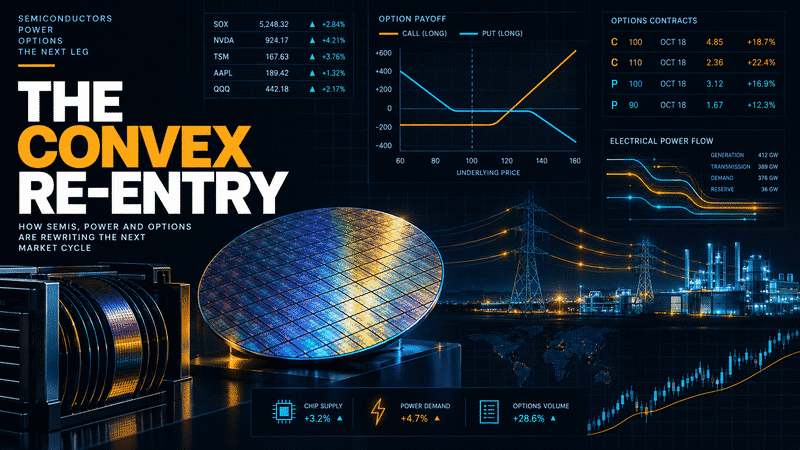
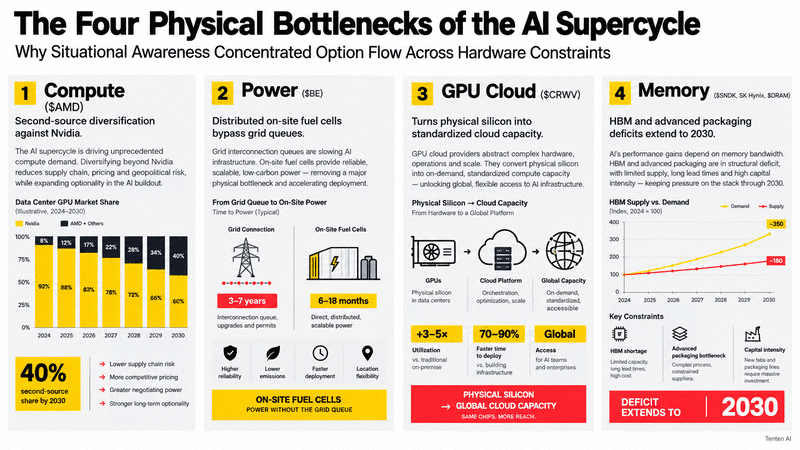
Following the July 2026 market deleveraging, Leopold Aschenbrenner has re-entered the AI trade. The former OpenAI researcher and founder of Situational Awareness deployed hundreds of millions of dollars in option premiums and custom FLEX options. Rather than taking leveraged margin loans on long equity, this strategy caps downside losses while preserving upside convexity. The fund concentrates on four physical bottlenecks in the AI supercycle: second-source compute provider AMD, datacenter power specialist Bloom Energy, GPU infrastructure host CoreWeave, and the structurally tight memory semiconductor complex.
During the summer of 2026, tech equities suffered a sharp global unwind. Commentators quickly declared an end to the multi-year artificial intelligence infrastructure expansion. Among high-profile macro casualties was Leopold Aschenbrenner, author of the widely discussed 165-page thesis Situational Awareness. His fund held heavily concentrated positions in semiconductor memory and hardware, suffering severe margin calls when leverage washed out of macro markets in July.
Two months later, the young fund manager returned. Reporting by CNBC anchor David Faber reveals that Situational Awareness re-entered the derivatives market during early September. The fund paid hundreds of millions of dollars solely in option premiums, mounting an aggressive yet structurally protected campaign across core AI infrastructure providers.
From Forced Liquidation to Structural Convexity: The Strategic Shift in Trading Architecture
In hedge fund management, predicting secular macro trends correctly while misjudging liquidity volatility is an expensive lesson.
At the close of the second quarter of 2026, Situational Awareness maintained an extraordinarily concentrated portfolio. Filings indicated that SanDisk ($SNDK) and Micron ($MU) alone comprised roughly 56% of its reported US equity holdings. When the unwind of yen carry trades and macro de-risking spiked broker margin requirements, the fund faced liquidity constraints at cyclical market troughs.
This September deployment reveals a total tactical restructuring.
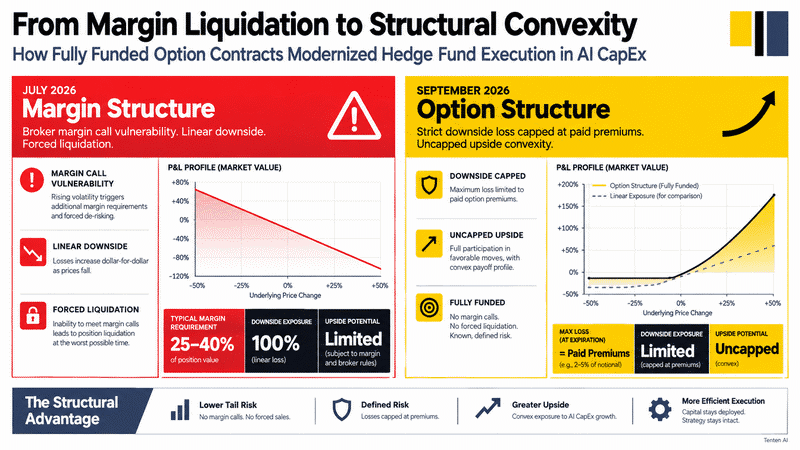
Instead of borrowing against equity portfolios, Aschenbrenner executed deep purchases of fully funded call options and exchange-cleared FLEX options.
This financial engineering offers two distinct institutional advantages:
- Hard downside caps: Maximum risk remains strictly limited to paid premiums. Sharp intraday selloffs cannot trigger broker-mandated portfolio liquidations.
- Uncapped structural convexity: If AI infrastructure stocks stage significant earnings recoveries, deeply leveraged upside exposure delivers exponential asymmetric returns.
The trade signals enduring institutional conviction. Aschenbrenner did not abandon his core thesis on exponential computing demand. He modernized the execution wrapper to isolate his capital from liquidity shocks.
Compute and Power Constraints: Why AMD and Bloom Energy Anchor Data Center Expansion
The fund's targeted option contracts trace four indispensable links in the physical hardware supply chain.
The first link addresses compute diversification. While Nvidia retains undisputed dominance in high-performance enterprise GPUs, Advanced Micro Devices ($AMD) provides critical second-source supply. Hyperscale operators such as Meta and Microsoft cannot afford single-vendor dependency as capital expenditure forecasts scale aggressively through 2027. AMD's MI300 and MI400 accelerator lines offer high price-performance ratios and essential capacity cushions.
The second link tackles energy constraints, the most unforgiving bottleneck in digital infrastructure.
Procuring acreage and assembling servers requires capital, but connecting high-density server clusters to utility grids takes between three and five years of municipal permitting. Bloom Energy ($BE) manufactures solid oxide fuel cells that generate on-site power without relying on municipal utility interconnections.
Bloom Energy sits squarely at the crossroads of data center demand and regional electricity shortfalls. When a gigawatt-scale computing campus faces millions of dollars in daily downtime costs, off-grid distributed power ceases to be an optional redundancy. It becomes a vital defensive moat.
The Memory Semiconductor Supercycle: Concentrated Option Bets Across SNDK, SK Hynix, and the DRAM ETF
The most aggressive derivative volume congregated in semiconductor memory assets. Situational Awareness directed heavy option flows into SanDisk ($SNDK), SK Hynix, and the Roundhill Memory ETF ($DRAM).
Retail investors frequently treat memory as a commodity exposed to boom-bust price swings. In modern AI clusters, however, memory bandwidth forms the primary physical constraint on model throughput.
Multiple structural drivers sustain this extended cycle:
- HBM and packaging shortages: Frontier generative models require unprecedented High Bandwidth Memory capacity, driving exponential volume consumption per socket.
- Persistent supply deficits: SK Hynix executives publicly confirmed that capacity for advanced memory packaging remains fully booked through late 2030.
- Wafer allocation cannibalization: Because major fabricators reallocate wafer starts toward HBM production, standard enterprise DDR5 and server NAND experience supply contractions, lifting baseline contract prices.
Market participants should note that the ticker "\(DRAM" does not represent an individual operating firm. It designates the Roundhill Memory ETF, an exchange-traded fund holding diversified exposure across worldwide memory manufacturers. Backing \)DRAM alongside single-stock options reflects a thematic commitment to long-term pricing power across the memory sector.
CoreWeave ($CRWV) rounds out the portfolio by monetizing compute capacity directly. As a specialized GPU cloud provider, CoreWeave packages scarce silicon and power into accessible compute time for frontier AI enterprises.
July Deleveraging vs. Real Demand: Why Wall Street Liquidated Leverage Rather Than the AI Thesis
Following steep market pullbacks, market narratives routinely confuse equity liquidation with deteriorating economic fundamentals.
The July selloff stemmed from financial de-risking, shifting rate expectations, and macro hedge fund deleveraging. It erased multiple expansion multiples on trading screens, yet hyperscaler capital expenditure budgets showed zero contraction. Alphabet, Microsoft, and Amazon affirmed during recent investor conferences that under-investing in AI infrastructure carries far greater enterprise risk than temporary over-building.
| Strategic Metric | July 2026 Margin Structure (Forced Liquidation) | September 2026 Option Structure (Convex Re-Entry) |
|---|---|---|
| Financial Vehicle | Leveraged common shares, margin debt facilities | Fully paid call options, bespoke FLEX contracts |
| Liquidity Exposure | Vulnerable to broker margin calls and liquidations | Zero margin risk; maximum downside capped at premium |
| Return Profile | Linear equity exposure with ongoing carrying costs | Non-linear upside convexity targeting valuation rebounds |
| Asset Breadth | Unbalanced equity bet (56% in memory stocks) | Diversified coverage across compute, power, cloud, memory |
| Underlying Premise | Assumed benign liquidity and low borrow rates | Accommodates extreme volatility via structural isolation |
Aschenbrenner's return to the derivatives market illustrates a broader institutional transition:
Model parameters expand relentlessly. Compute requirements escalate. Data centers face grid connection delays. Memory bandwidth remains constrained. These four engineering bottlenecks do not dissolve because trading desks reduce margin balances. When capital flows back toward defensive, supply-constrained hardware, disciplined operators using robust financial structures capture the next leg of the supercycle.
Frequently Asked Questions
What are FLEX Options and why do institutional hedge funds utilize them?
FLEX options are customized exchange-traded derivatives regulated by venues like the Chicago Board Options Exchange. They allow institutional managers to specify custom strike prices, exercise styles, and expiration dates. This customization matches strategic investment horizons without taking on counterparty credit risk common in over-the-counter transactions.
Why did Situational Awareness spend hundreds of millions in premiums instead of purchasing equity?
While option premiums represent significant upfront capital, they eliminate margin call vulnerability during turbulent market periods. If unexpected macro shocks depress share prices further, the fund cannot be forced into involuntary liquidation. This downside ceiling enables managers to maintain high-conviction positions without broker interference.
Has semiconductor memory escaped its traditional cyclical patterns?
Although memory production retains sensitivity to semiconductor equipment spending, AI demands have transformed industry economics. Packaging high bandwidth memory requires complex fabrication processes that limit rapid capacity expansion. These structural hurdles prolong supply constraints, converting typical short-term cycles into sustained multi-year shortages.
Author Insight
Capital markets periodically disconnect market prices from operational reality. The summer selloff led casual observers to declare the AI infrastructure boom finished, yet equipment backlogs for step-up transformers, server racks, and high bandwidth memory stretch well into late 2027. Situational Awareness illustrates the core discipline of institutional investing: when physical constraints remain unresolved, the correct response is not to abandon the thesis, but to choose financial instruments that survive volatility while capturing exponential upside.