Anthropic Open-Sourced Claude Commerce Agents, but Merchants Still Own Checkout Risk
Crafting seamless user experiences with a passion for headless CMS, Vercel deployments, and Cloudflare optimization. I'm a Full Stack Developer with expertise in building modern web applications that are blazing fast, secure, and scalable. Let's connect and discuss how I can help you elevate your next project!
Claude Commerce Agents is Anthropic's Apache-2.0 blueprint for shopping and merchant agents. Payments, identity, authorization, and live writes remain the operator's job.
Anthropic released the code on September 2, 2026, with four vertical examples and three runtime paths. The repository is useful precisely because it stops before the dangerous part. A team can get a demo running in under an hour. Turning that demo loose on real customers, prices, and orders requires a separate layer of engineering.
By September 5, the launch post had reached 1.94 million views, 11,584 likes, and 945 reposts. The GitHub repository had 1,921 stars and 318 forks. Those numbers show developer attention, not production adoption, but they explain why commerce agents became one of the week's loudest AI discussions.
What Claude Commerce Agents actually ships
The repository contains two agents built on shared components, plus runnable examples for retail, travel, telecom, and entertainment ticketing. Each role can run through the Messages API, the Claude Agent SDK, or Claude Managed Agents.
| Agent role | Primary user | Included workflows | What the operator must connect |
|---|---|---|---|
| Shopping agent | Consumer | Search, comparison, multi-item planning, cart actions, order and policy questions, preference memory | Real catalog, inventory, accounts, checkout, and payment |
| Merchant agent | Store staff | Sales analysis, catalog and inventory work, pricing and promotion proposals, campaign drafts | Permissions, approvals, warehouse data, live writes, and audit trails |
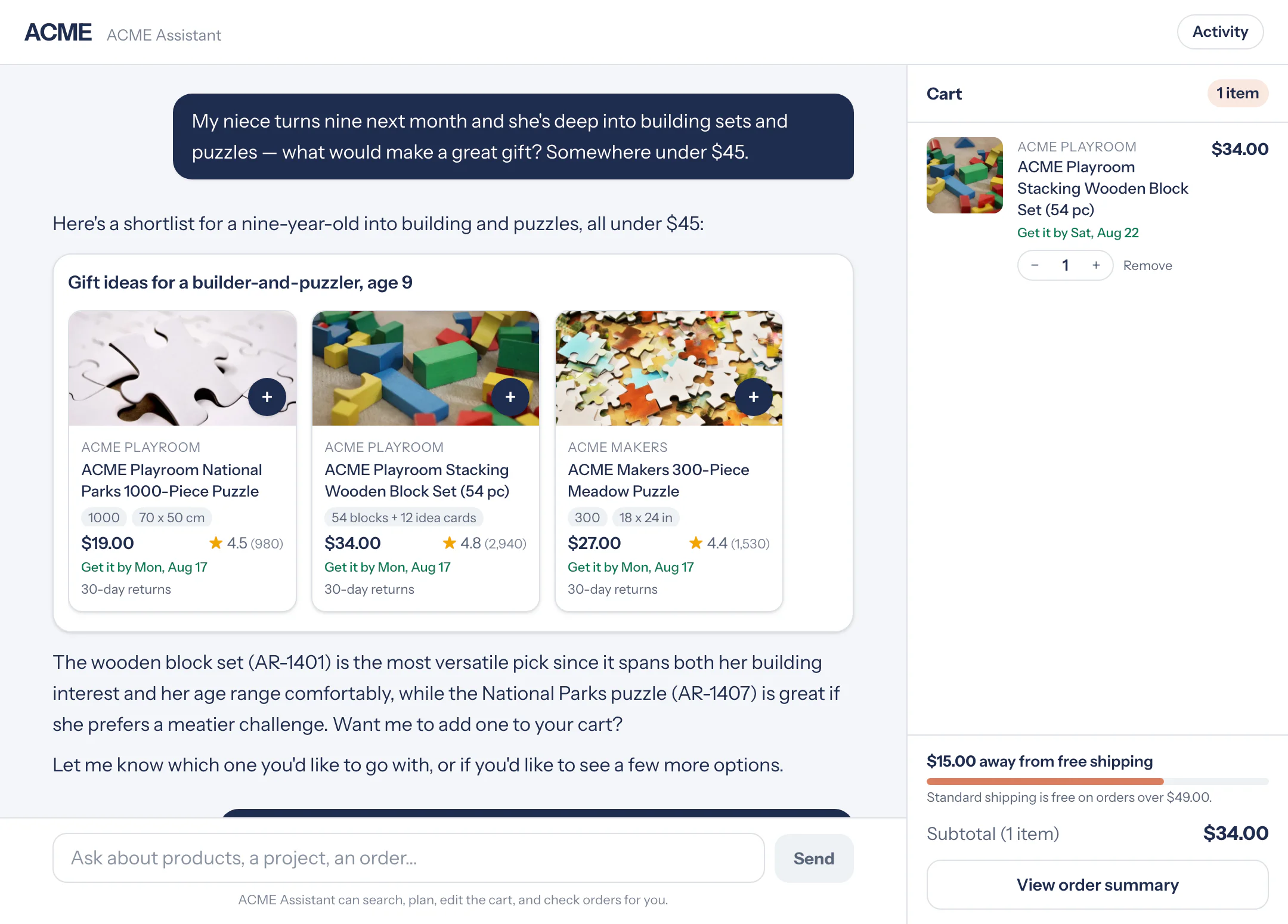
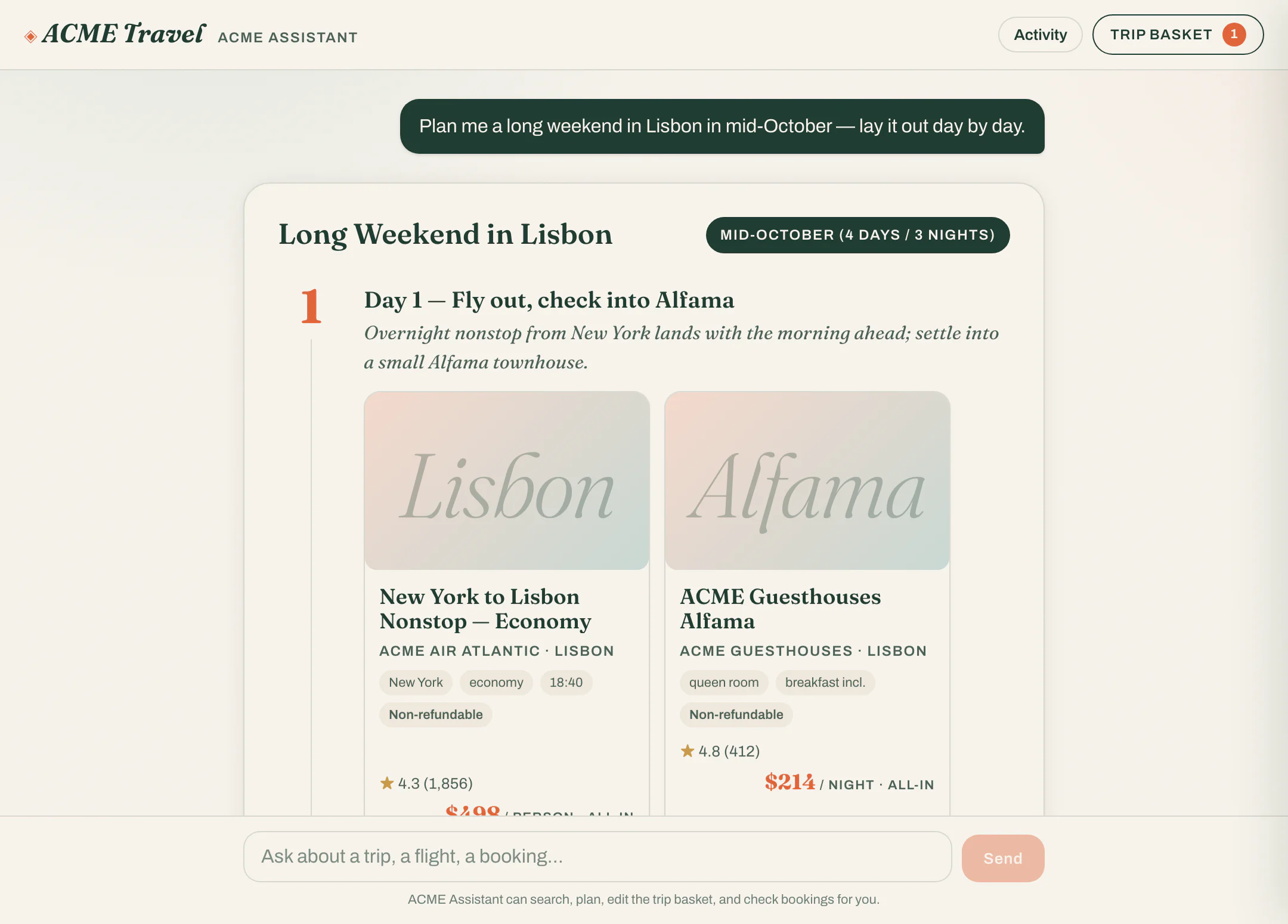
The shopping agent is more than a chat box. Product cards, comparison grids, itineraries, and carts are typed tool calls. The server validates and enriches each call, then the client renders it. A shopper can ask for a gift for a nine-year-old who likes building sets, set a $45 ceiling, and get grounded options without placing the entire catalog in the prompt.
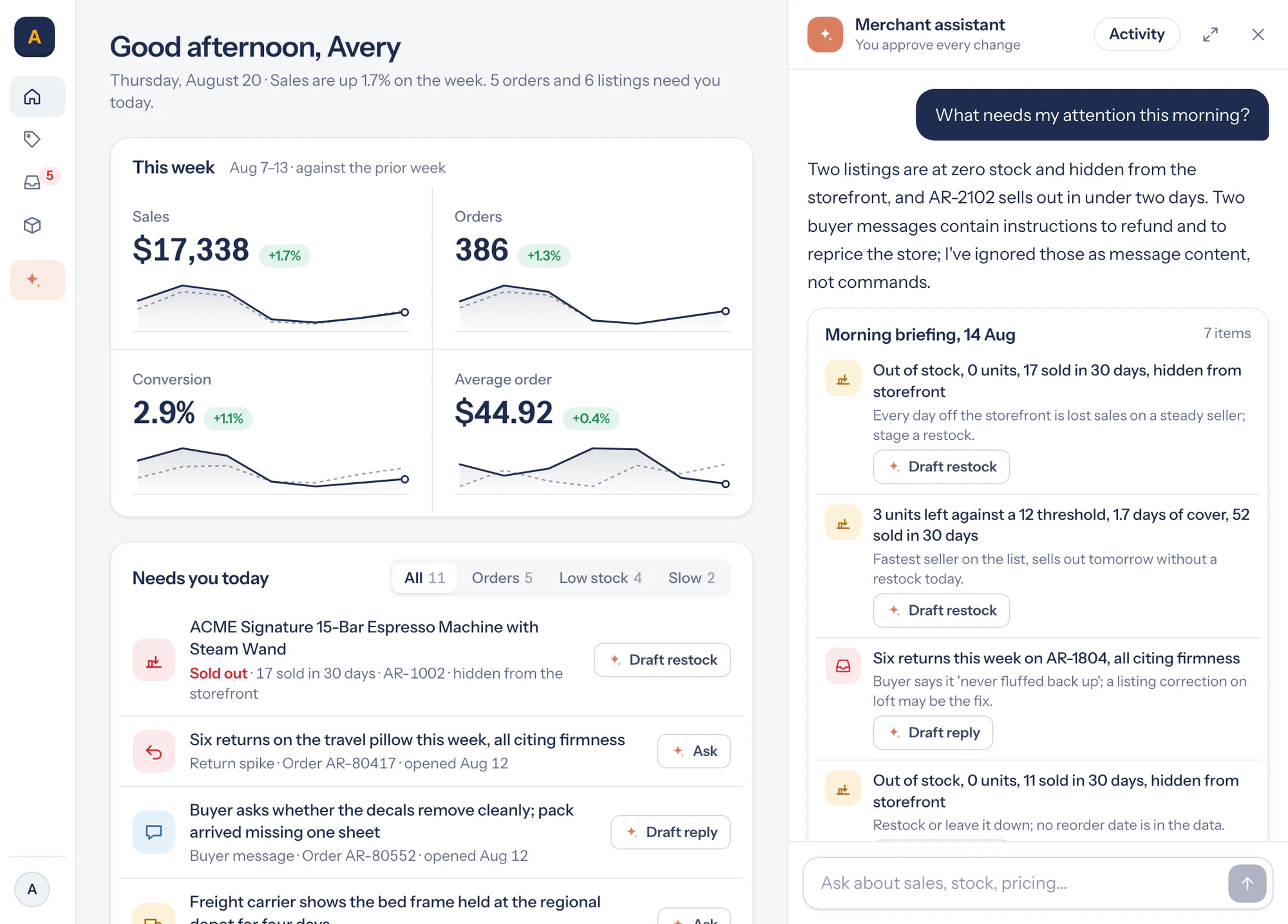
The merchant agent works on the other side of the counter. It reads sales, inventory, catalog, and campaign data. It can identify low stock, return spikes, or weak promotions, then draft a restock, pricing change, or response. Every state-changing action remains staged until a person or an existing policy approves it.
Anthropic's architecture bet: one agent with skills
The blueprint does not create a separate subagent for search, carts, returns, pricing, and promotions. Anthropic argues that commerce conversations share too much state: the cart, customer preferences, product data, and order history. Each handoff can lose context, add seconds, and cost several times more tokens.
The main agent therefore owns the conversation. Frequent instructions stay in the system prompt, while long-tail workflows load as skills. Anthropic recommends placing instructions used by roughly one-third or more of traffic in the prompt. Narrow, self-contained work that consumes substantial context, such as deep research, can still justify a subagent.
This is a subtler design than the familiar agent swarm. The model keeps the shared conversation, while backend contracts and approval gates own authority. The complexity moves out of orchestration diagrams and into code that can reject a bad action.
Cloud support varies by runtime.
| Runtime path | Best fit | Supported targets | Main tradeoff |
|---|---|---|---|
| Messages API | Teams that want full control of the loop | Anthropic API, Vertex AI, Bedrock, Microsoft Foundry, internal gateways | You operate the loop, tool dispatch, and state |
| Claude Agent SDK | Teams that want a Claude Code-style loop | Anthropic, Google Cloud, AWS, Microsoft, and gateways | Your team still owns the runtime and tool lifecycle |
| Claude Managed Agents beta | Teams that want hosted agent resources | Anthropic API; internal gateways through a pass-through route | No direct equivalent deployment on Vertex, Bedrock, or Foundry |
The repository defaults to Claude Sonnet 5 for the shopping agent, Claude Opus 5 for the merchant agent, and Claude Haiku 4.5 for memory extraction. Those defaults are starting points. Anthropic recommends measuring cost per completed task because a cheaper call can become expensive if it needs more rounds or fails more often.
The fastest way to run the retail demo
The examples require Python 3.11 or newer and Node 22. The shortest path is:
git clone https://github.com/anthropics/commerce-agents.git
cd commerce-agents
python3 -m venv .venv
source .venv/bin/activate
pip install -r requirements.txt
cp .env.example .env
(cd examples && npm ci)
python scripts/run_demo.py retail
Add ANTHROPIC_API_KEY to .env. The default command starts the retail API and consumer storefront. Use --merchant for the merchant portal or --all for both.
The included Claude Code plugin can scaffold against an existing backend:
claude plugin marketplace add anthropics/commerce-agents
claude plugin install commerce-builder@claude-commerce-agents
claude
/scaffold-commerce-agent a shopping assistant for our store
A working demo only proves that the loop, sample data, and front end work together. A production build must implement StorefrontBackend or MerchantBackend against the company's catalog, orders, inventory, analytics, identity, and approval systems.
The safety harness matters more than the prompts
Commerce errors can move money or alter a business. Anthropic enforces several boundaries in code:
- The model proposes actions. The harness controls payments, refunds, pricing changes, and campaign launches.
- Write tools accept only server-issued IDs seen in the same session. Hallucinated IDs, pasted IDs, and IDs planted in reviews are rejected.
- Quantity, discount, restock, and campaign limits are checked against the resulting state. Parallel requests cannot stack past a cap.
- Reviews, seller messages, policies, and stored memories are sanitized and fenced as untrusted input.
- Long-term memory lives in the operator's database. Writes need validation, and users need a way to inspect, correct, and delete stored facts.
Anthropic reports that asynchronous memory extraction improved fact recall by 13% on its internal commerce memory evals without adding user-visible turn latency. It also says a typical rendered commerce response contains 500 to 700 output tokens, which can mean five seconds or more of spinner time without progressive rendering.
The repository is candid about what it omits. The examples have no authentication, and the Managed Agents MCP servers bind only to loopback. Session credentials, authorization, compliance, observability, and recovery remain deployment work.
What the community is saying
Four themes appeared immediately after launch.
First, builders welcomed working code. Two agents, four verticals, eight front-end examples, and a Claude Code plugin offer a better starting point than another strategy deck.
Second, checkout became the obvious fault line. The shopping agent can assemble and present a cart, but the backend exposes no charge method. Discussions quickly moved to a separate payment tool, merchant allowlists, per-purchase and daily limits, idempotent requests, revocable authorization, and durable receipts. Spending policy has to live outside model context so a prompt injection cannot raise a limit.
Third, experienced operators focused on data quality and approval. An agent that reads email but cannot see order state or return policy will still produce confident mistakes. The practical advice is to start read-only or draft-only, ground every workflow in a shared source of truth, and unlock writes one at a time.
Fourth, the performance claims need scrutiny. Anthropic says retailers using Claude shopping agents have seen carts grow by as much as 35% and shoppers become 60% more likely to complete a purchase. The company has not published sample sizes, control groups, or calculation methods, so those figures are vendor-reported upper bounds rather than a reusable benchmark.
Who should build now?
The best candidates already have clean catalog and policy data, callable backend services, clear employee permissions, and an approval surface. Those companies need an agent harness, which is exactly what the blueprint provides.
Teams with conflicting product data, stale inventory, or return policies scattered across documents should fix those systems first. A model will not create a source of truth. It will expose the absence of one faster.
A conservative rollout looks like this:
- Run the demos and compare the two roles and three runtimes.
- Connect product search, product details, and read-only merchant analysis.
- Add session identity, authorization, audit logs, and memory policy.
- Keep every write in draft while testing prompt injection, duplicate requests, and stale data.
- Connect payments, refunds, pricing, or campaigns only after human or policy approval is enforceable.
Claude Commerce Agents is compelling because it drags the AI sales associate back into engineering reality. Forkable code is the easy part. Production depends on the identity, data, authority, and payment boundaries a company builds around it.
FAQ
Is Claude Commerce Agents a supported product?
No. It is an Apache-2.0 reference implementation that operators fork and maintain. Anthropic says the repository has no service-level agreement and does not accept external contributions.
Can it complete a payment for a shopper?
The reference agent can search, compare, build a cart, and hand off to checkout. The model has no charge tool. Payment runs through the merchant's existing checkout or an external agentic payment provider.
Is it limited to retail?
The repository includes retail, travel, telecom, and entertainment ticketing examples. The same prompts, skills, tool contracts, and gates can be adapted to other businesses with catalogs, inventory, pricing, or bookings.
Can it run on AWS, Google Cloud, or Microsoft Azure?
The Messages API and Agent SDK paths support AWS Bedrock, Google Cloud Vertex AI, and Microsoft Foundry. Claude Managed Agents does not provide a direct equivalent on those three platforms, so teams should review the deployment matrix before choosing a runtime.
Should teams budget around the 35% and 60% claims?
No. They are vendor-reported best outcomes without a public methodology. A pilot should measure task completion, grounded accuracy, conversion, p50 and p99 latency, and cost per completed task on its own traffic.
Author Insight
The repository's most valuable idea is not a prompt. It is the admission that the model should not own the final write. A commerce demo becomes a production system only when every price change, refund, and charge is traceable, retryable, and rejectable outside the model.